 Get 30% Off On Selected Items

Why Can Power Banks Catch Fire or Explode? Recent Real Cases, Magnetic Power Bank Safety Risks and How to Choose a Safer Product
Power banks have evolved from occasional backup devices into everyday consumer electronics. Magnetic wireless power banks have taken this one step further: instead of staying inside a bag until needed, they can attach directly to the back of a compatible phone and provide portable charging during travel, commuting, work and outdoor use.The added convenience comes with greater engineering complexity. A modern magnetic power bank may combine a lithium-ion battery, charging circuitry, wireless charging coils, magnets, power-conversion components, a protection system and a compact enclosure.
That is why safety cannot be judged by headline specifications such as “5,000mAh”, “10,000mAh” or “20W”. Battery-cell quality, protection circuitry, thermal design, wireless charging architecture, materials, assembly and manufacturing controls all influence the safety of the final product.US and Canadian regulators have documented multiple recalls and safety warnings involving wireless, magnetic and portable power banks in recent years. Some are especially recent. In April 2026, the US Consumer Product Safety Commission reannounced the recall of Casely Power Banks and reported that, after the original recall, 28 additional incidents involving overheating, expansion or fire had been reported. Those included one fatality and one serious incident on an aircraft.
These events do not mean that all magnetic power banks are unsafe. Nor can a product’s price alone determine whether it is dangerous.The more useful conclusion is that a lithium-ion magnetic power bank must be engineered, manufactured, tested and used as a complete battery system.
Recent Real Cases: What Has Happened with Magnetic Power Banks?
One important point should be made at the beginning: a recall does not mean every product in a category is dangerous. A recall identifies a specific model, batch or design problem that regulators or manufacturers believe creates an unacceptable risk.
The recent magnetic and wireless power-bank cases are useful because they show how failures can occur at different points in the overall system.
Casely Power Pods: 2026 Reannouncement and a Reported Fatality
View the official CPSC Casely 2026 recall notice
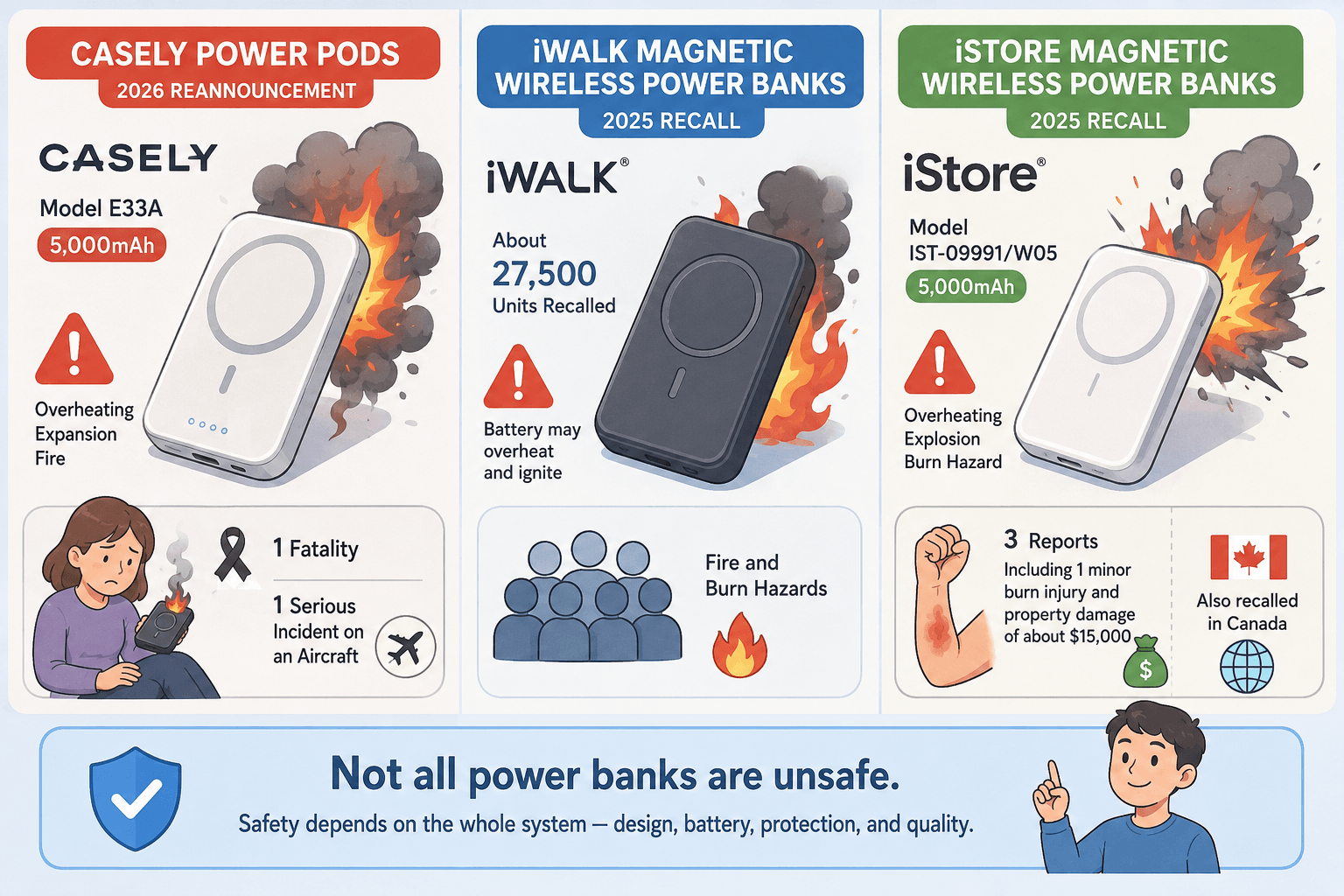
This may currently be one of the most significant recent cases involving a magnetic wireless power bank.On 16 April 2026, the US CPSC reannounced the recall of Casely Wireless Portable Power Banks, model E33A, a 5,000mAh MagSafe-compatible portable wireless phone charger.According to the CPSC, the company had received 51 reports of overheating, expansion or fire when the product was originally recalled in April 2025, including six minor burn injuries.
After that recall, another 28 reports were received. These included overheating, expansion and fire, as well as one reported fatality and a serious incident on an aeroplane. The CPSC said that in August 2024, a 75-year-old woman in New Jersey was charging her phone with the power bank on her lap when the unit caught fire and exploded. She suffered second- and third-degree burns and later died from complications related to her injuries. In February 2026, a 47-year-old woman was charging her phone with the power bank on an aircraft when it caught fire and exploded, resulting in first-degree burns.These details come from an official regulatory document rather than an unverified social-media post.
iWALK Magnetic Wireless Power Banks: About 27,500 Units Recalled in 2025
View the official CPSC iWALK recall notice
Another directly relevant example is iWALK.On 29 May 2025, the CPSC announced a recall involving approximately 27,500 iWALK Magnetic Wireless Power Banks. The agency stated that the lithium-ion batteries could overheat and ignite, creating fire and burn hazards and potentially causing serious injury or death.The products were compact magnetic wireless power banks, making this case particularly relevant to consumers shopping for slim magnetic charging products.
iStore Magnetic Wireless Power Banks: Overheating, Explosions and a Reported Burn Injury
View the official US CPSC iStore recall notice
View the Canadian recall notice
The iStore case provides another direct example.The CPSC recall involved iStore Magnetic Wireless Power Banks, model IST-09991/W05. The lithium-ion battery could overheat and ignite while charging. The company received three reports of the power banks overheating and exploding, including one case involving a minor burn to the user’s arm and approximately $15,000 in property damage.
Canadian authorities also issued a recall notice for the same 5,000mAh magnetic wireless power bank, reporting that the product could overheat and expand during normal use.
ESR HaloLock: Recall Expansion Involving Wireless Magnetic Power Banks
View the official CPSC ESR recall expansion
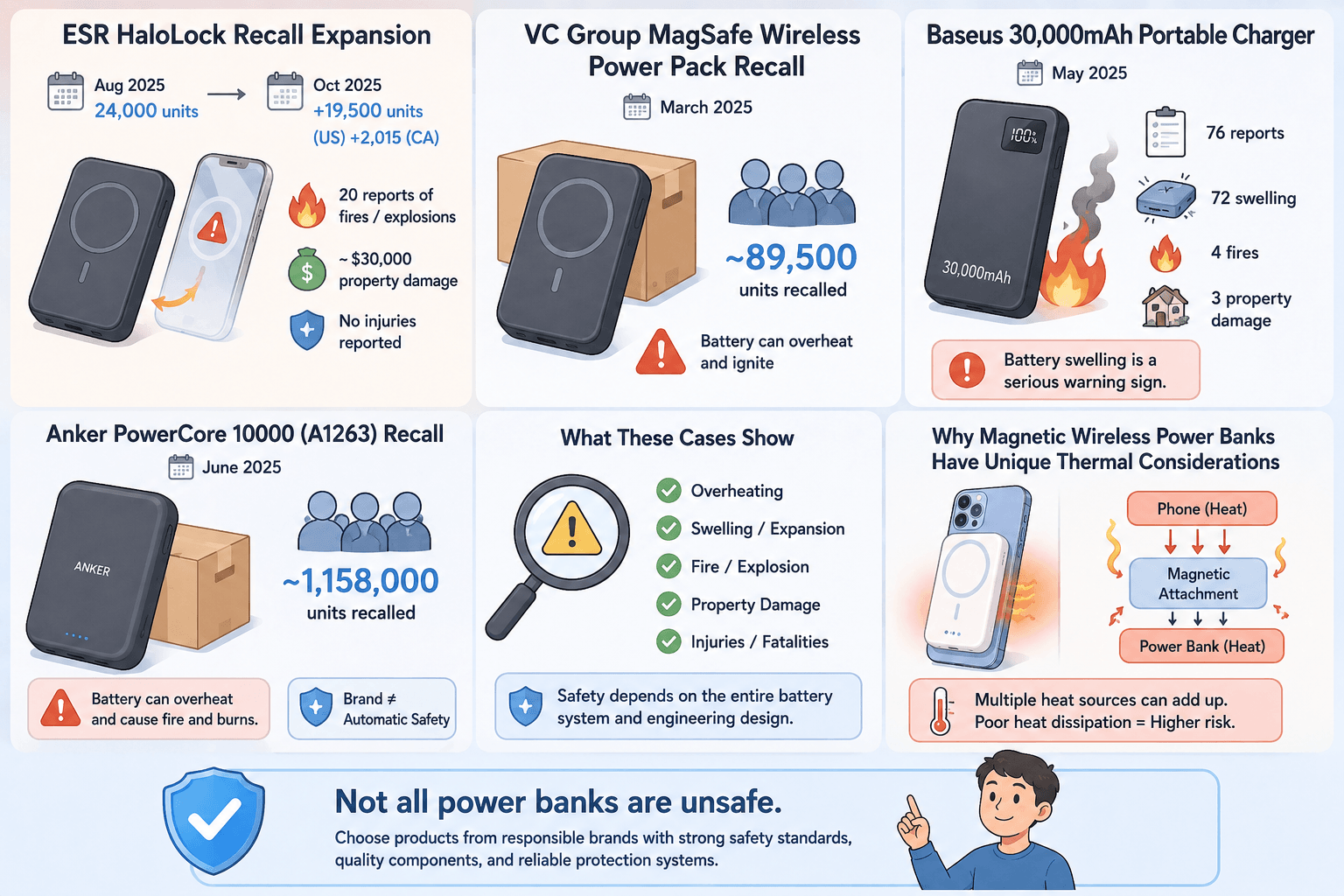
The ESR HaloLock case demonstrates another important aspect of product safety: a recall can expand when additional affected configurations are identified.In August 2025, the CPSC recalled approximately 24,000 ESR HaloLock Wireless Power Banks covering models 2G520, 2G505B and 2G512B because the lithium-ion batteries could overheat and ignite.
On 9 October 2025, the recall was expanded to include model 2G505, involving approximately 19,500 additional units in the US and about 2,015 in Canada.By that stage, the company had received 20 reports of batteries catching fire and exploding, with approximately $30,000 in property damage and no reported injuries.
VC Group MagSafe Wireless Power Pack: Approximately 89,500 Units Recalled
View the official CPSC VC Group recall notice
In March 2025, the CPSC announced a recall involving approximately 89,500 VC Group MagSafe Wireless Power Pack portable power banks.The product was a 5,000mAh wireless portable battery designed for MagSafe-compatible phones and earphones. The CPSC stated that the lithium-ion battery could overheat and ignite.
Again, the key lesson is that terms such as “MagSafe-compatible”, “wireless” and “magnetic” describe functionality, not safety.Safety comes from the battery system and the complete engineering design.
Baseus 30,000mAh Portable Charger: 76 Reports and Four Fires
View the official CPSC Baseus recall notice
Although this is not a magnetic model, it provides useful context.In May 2025, the CPSC recalled approximately 55,380 Baseus 65W 30,000mAh portable chargers. The company had received 76 incident reports, including 72 reports of swelling and four reports of fire, with three involving property damage.The broader lesson is important:
Battery swelling is not merely a cosmetic defect. It is a warning sign that should be taken seriously.
Anker: A Major Brand Is Not Automatically Immune to Battery Defects
View the official CPSC Anker A1263 recall
The 2025 Anker recall provides another useful perspective.On 12 June 2025, the CPSC recalled approximately 1,158,000 Anker PowerCore 10000 power banks, model A1263, because the lithium-ion battery could overheat and create fire and burn hazards.This does not mean major brands are inherently unsafe.It means battery safety depends on the specific product, configuration, manufacturing history and corrective action—not simply on brand recognition.
Why Do Magnetic Wireless Power Banks Have Unique Thermal Considerations?
Magnetic wireless charging introduces an additional thermal consideration: the wireless charging coil.With wired charging, electrical energy travels through a physical cable. Wireless charging relies on electromagnetic coupling between transmitting and receiving coils, and energy conversion is not perfectly efficient.Some energy becomes heat.
When the phone and power bank are physically attached, heat from both devices can accumulate around the contact area. If the phone is also under heavy load, the system may have several simultaneous heat sources.This creates a thermal challenge that is different from a conventional wired power bank.
Why Does a Strong Magnet Not Mean a Safer Product?
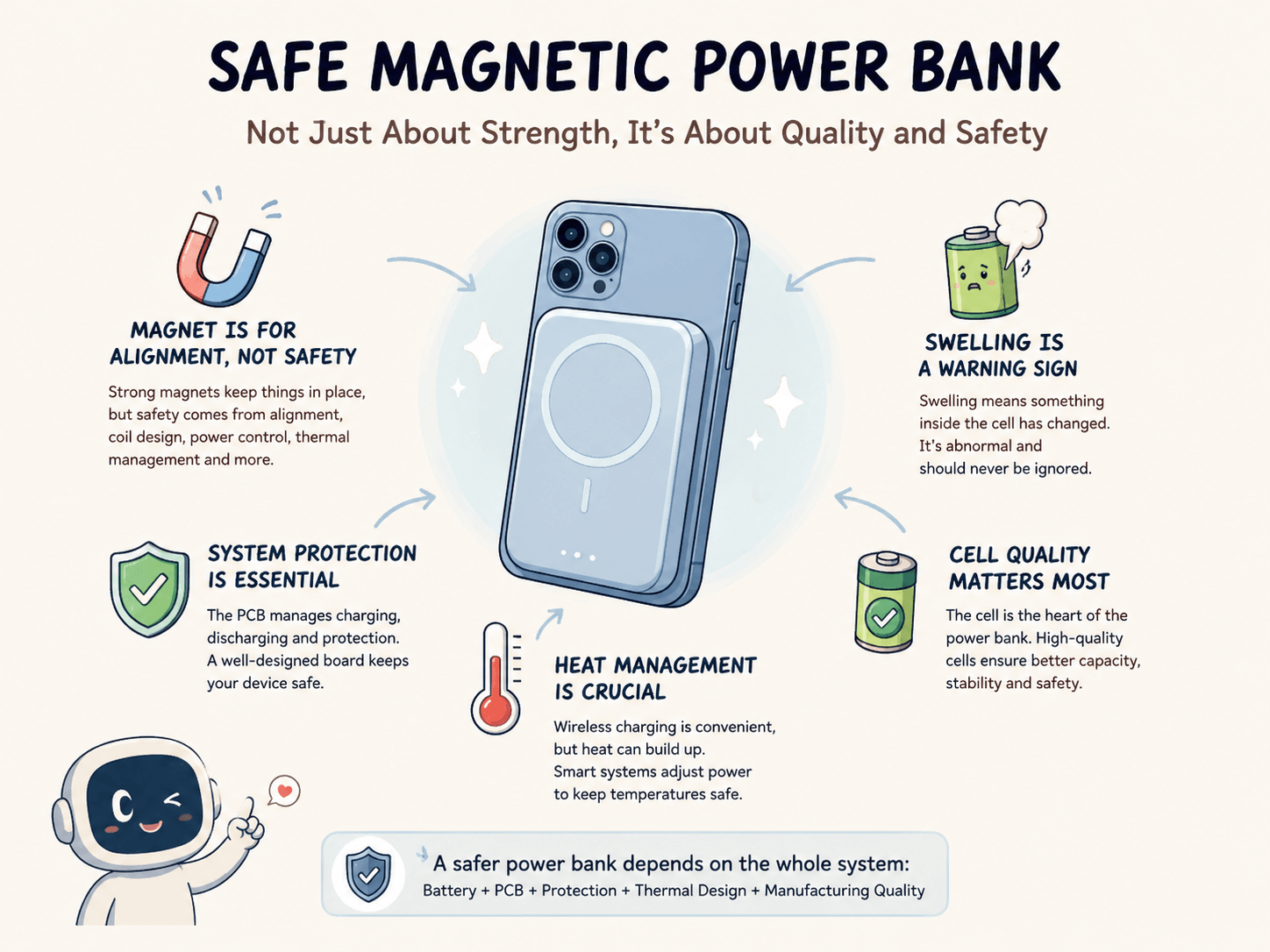
Consumers may focus heavily on magnetic strength.However, magnets mainly help keep the charging surfaces aligned.Safety depends much more on alignment accuracy, coil design, wireless power control, thermal monitoring, power stability and heat dissipation.
A strong magnetic connection cannot compensate for poor thermal engineering.In fact, if a device generates excessive heat while remaining firmly attached to a phone, the close physical contact can make heat management even more important.
Why Can a Power Bank Swell?
Battery swelling is often a physical sign that something inside the cell has changed.Ageing, overheating, damage or internal failure can lead to gas generation and increased internal pressure, causing the cell or enclosure to expand.
Swelling does not mean that every device will immediately catch fire, but it is an abnormal condition and should not be ignored.The slim form factor of magnetic power banks can make swelling especially noticeable because there is little spare internal space.
Why Should Battery Cell Quality Matter So Much?
The cell is the energy source of the entire power bank.Poor cell consistency can affect capacity, internal resistance, self-discharge and thermal behaviour.Even when a batch has an acceptable average capacity, individual cells may vary significantly if incoming materials are not controlled properly.
A mature manufacturing process therefore needs incoming battery inspection and appropriate sorting.Consumers face a practical problem: most of these details are invisible from the outside.A label saying “5,000mAh” does not tell you the quality grade of the cell.That is why manufacturer transparency, quality records, testing and relevant compliance information matter.
Why Does the PCB Matter Too?
Consumers often focus on the battery first.But the battery is only one part of the system.The PCB manages charging, discharging, power conversion, protocol negotiation and protection.A properly designed board needs to control the operating state of the battery and reduce or interrupt unsafe conditions when necessary.
Poor conversion efficiency also creates additional heat.Inadequate protection can make abnormal conditions harder to control.Unsuitable power components can contribute to higher temperatures under load.A safer product therefore depends on the whole system:
Battery + PCB + Protection + Thermal Design + Manufacturing Quality.
Why Does Wireless Charging Require Careful Thermal Management?
The main advantage of wireless charging is convenience.But that convenience also means the user usually keeps the power bank and phone in a fixed relationship throughout charging.If heat rises, the user may not immediately realise how much thermal stress is developing inside the system.
Well-designed wireless charging systems therefore need dynamic management of power and temperature.When conditions become unsuitable, the system may reduce charging power instead of continuously operating at the advertised maximum.This is why:
“20W maximum output”
does not mean:“20W continuously under every condition.”
Wireless charging must balance speed, temperature, efficiency and battery protection.
Why Are Summer, Cars and Travel Particularly Important?
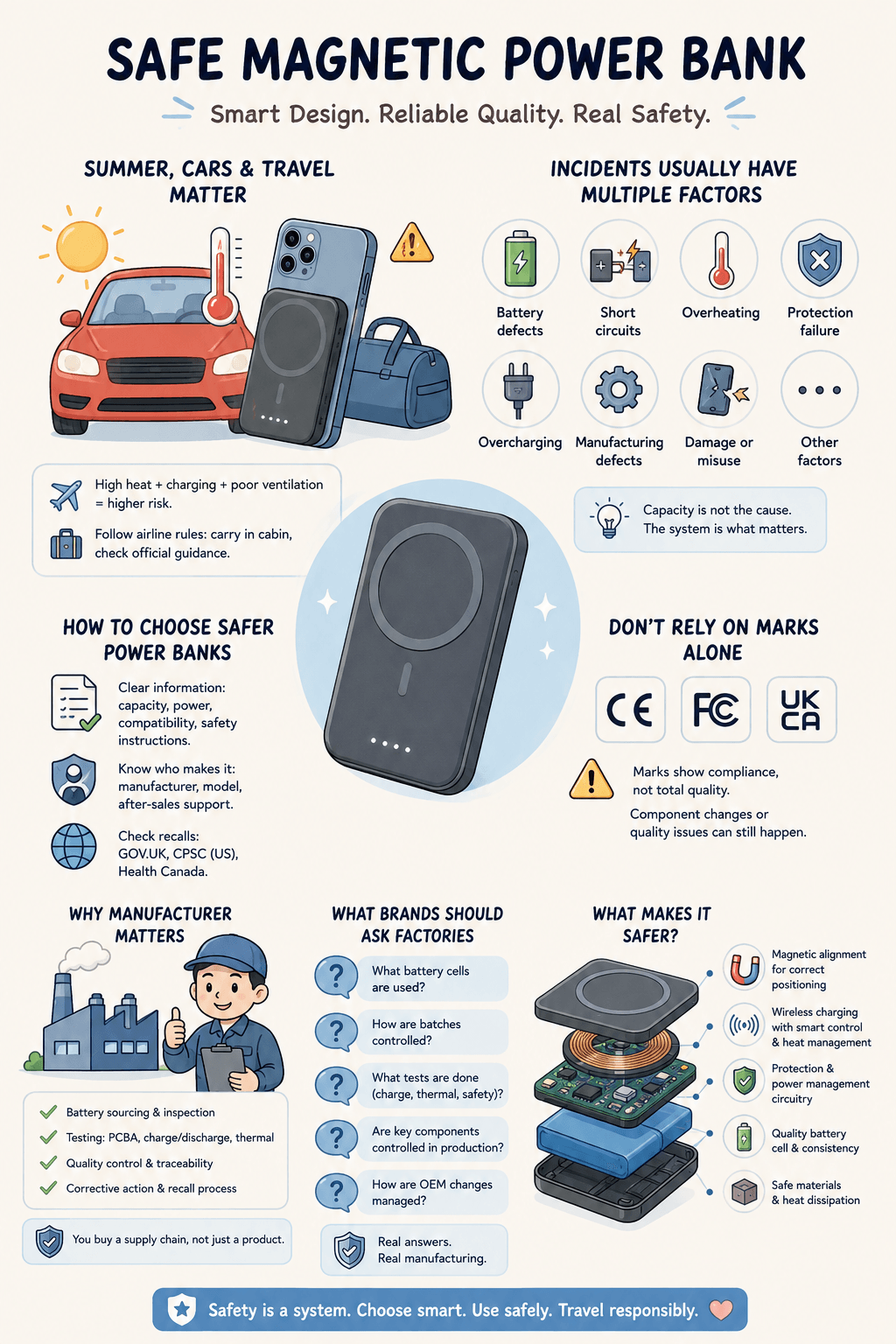
The same power bank can experience very different conditions in an office and inside a hot vehicle.A closed car exposed to strong sunlight can become extremely hot.If a magnetic power bank is attached to a phone at the same time, both devices may generate heat.If the combined device is then placed inside a bag or against materials that restrict ventilation, thermal stress can increase further.
Air travel is another important consideration.Airlines and aviation authorities increasingly require power banks to be carried in the cabin rather than checked baggage, with specific rules on storage and use. Recent guidance from Jet2 again highlighted lithium-battery precautions and referenced previous in-flight power-bank fire incidents.For brands, these real-world environments should be part of product instructions and risk assessment.
Battery Incidents Usually Have More Than One Contributing Factor
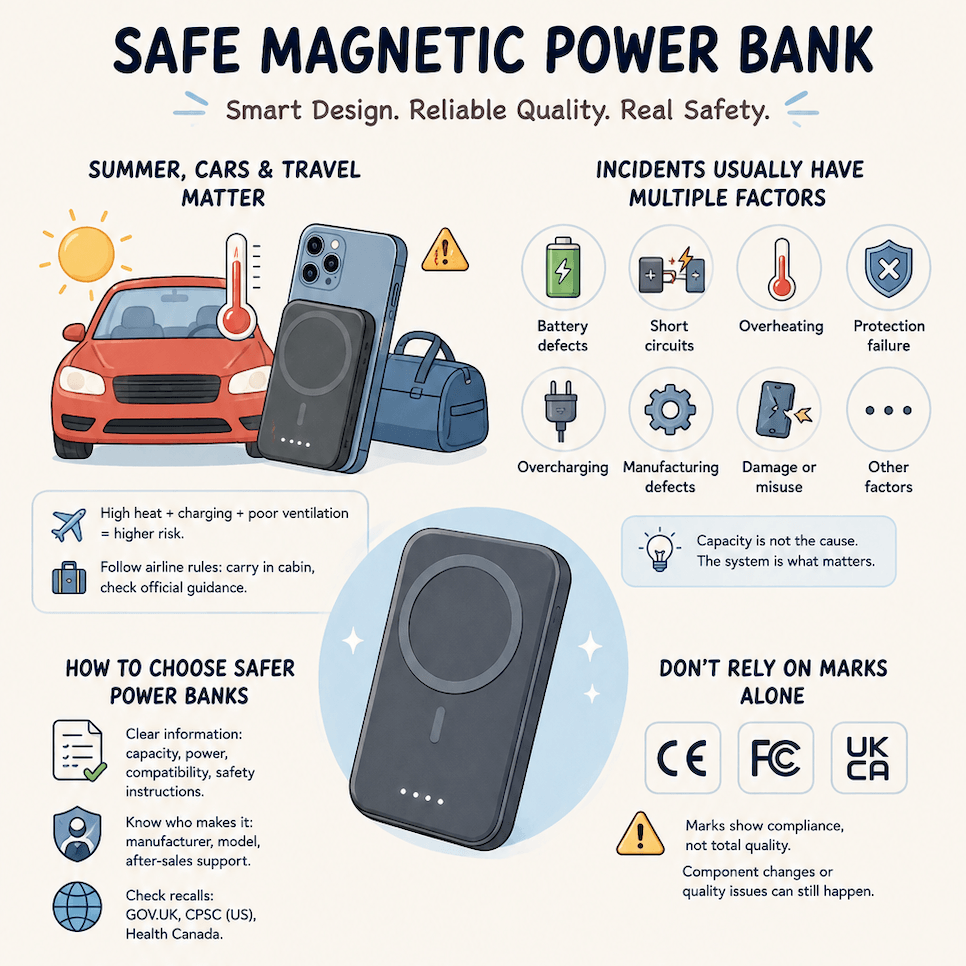
News reports often use the simple phrase “power bank exploded”.From an engineering perspective, serious incidents usually involve a combination of contributing factors rather than one single specification.Possible contributors include battery defects, internal short circuits, overcharging, mechanical damage, excessive heat accumulation, protection failures, charging-component problems, manufacturing defects or misuse.
That is why it is misleading to say that capacity alone causes a power bank to explode.A 5,000mAh product can fail.A 30,000mAh product can also be manufactured safely.The engineering system matters more than a single number.
How Can Consumers Identify a Safer Magnetic Power Bank?
The safest buying decision should not be based on a “Fast Charge” label alone.Look for transparency.A credible product should provide clear information about battery capacity, input and output, wireless charging power, compatibility, operating limitations and safety instructions.If the seller cannot clearly identify the manufacturer, product model or after-sales process, traceability becomes difficult.
Recall information is also worth checking.UK consumers can use the GOV.UK product safety alerts and recalls database. US consumers can use the CPSC recalls database, while Canadian customers can consult Health Canada’s Recalls and Safety Alerts.These government databases provide a much stronger basis for safety checks than online star ratings alone.
Why Should You Not Rely on CE, FCC or UKCA Marks Alone?
Compliance markings matter, but they should not be interpreted as a blanket guarantee of product quality.CE, UKCA and FCC relate to different regulatory frameworks and requirements, and the applicable obligations depend on the product and target market.A product can meet a regulatory requirement while still suffering from a later manufacturing-quality problem.
For example, if critical components such as the battery, PCB or charging architecture are changed during production, those changes may need to be assessed appropriately.This is particularly important for OEM buyers managing factories and product configurations.
Why Finding a Qualified Power Bank Manufacturer Matters
A consumer buys a power bank.A brand actually buys a supply chain.A capable manufacturer should be able to explain battery sourcing, incoming inspection, cell-batch control, PCBA testing, charge/discharge testing, thermal verification, finished-product inspection, traceability, corrective action and recall procedures.
Product photography cannot answer those questions.This becomes even more important for magnetic power banks because battery, wireless charging, magnetic alignment, power management and thermal behaviour are closely connected.
What Should Brands Ask a Power Bank Factory?
For B2B buyers, the best questions focus on information that can be verified.Ask what type and specification of battery cells are used, how battery batches are controlled, how charge/discharge and thermal tests are performed, whether critical components are controlled during mass production and how OEM changes are kept consistent with the approved sample.
A genuine manufacturer should be able to connect these answers to actual production procedures.A supplier that can only say “best price”, “fast delivery” and “high quality” is offering marketing language, not manufacturing evidence.
What Makes a Magnetic Power Bank Safer?
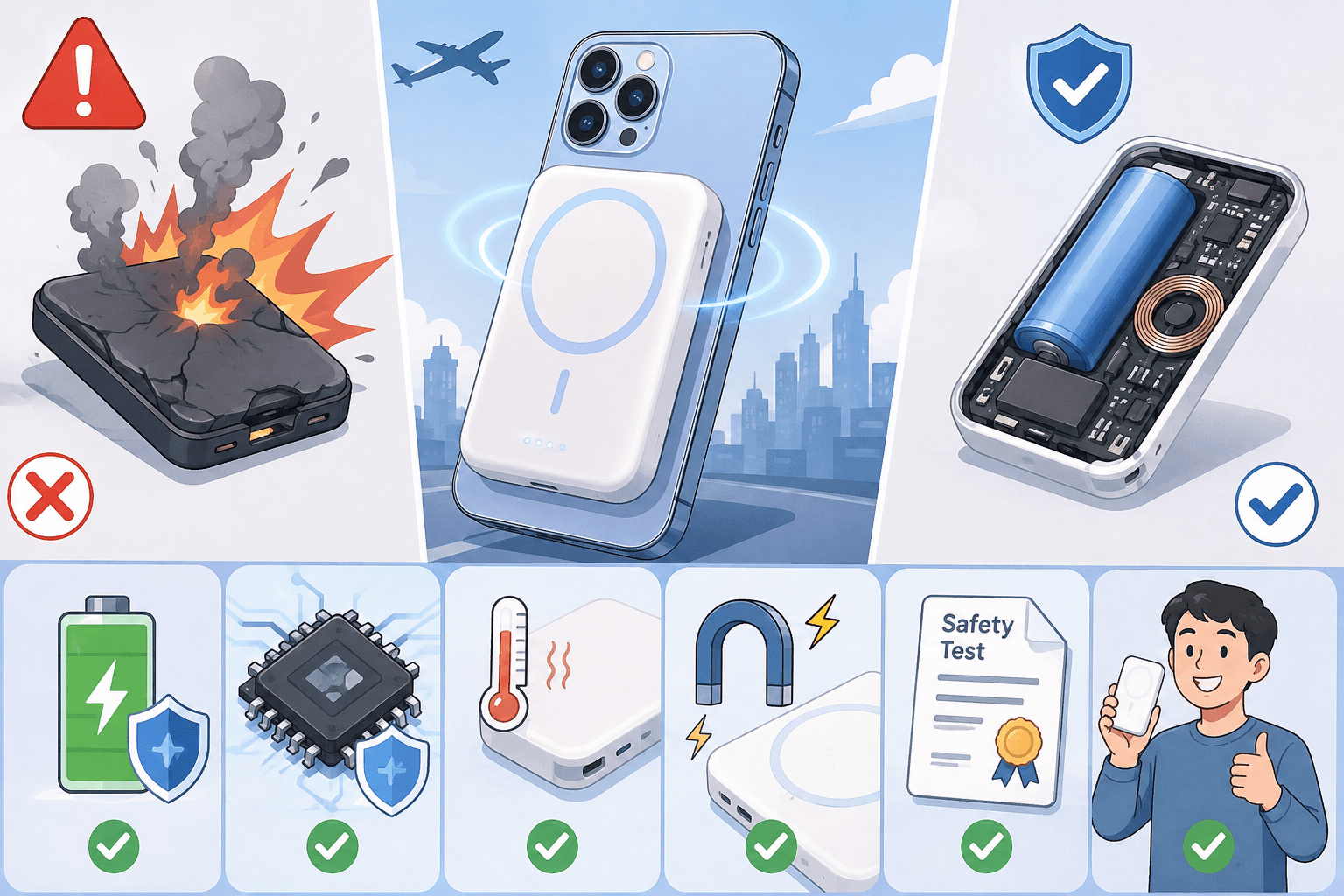
A safer magnetic power bank is not created by one component.It starts with a battery cell appropriate for the design and controlled for consistency.It continues with protection and power-management circuitry.
The wireless charging system needs appropriate coil placement, power control, foreign-object considerations and thermal management according to its architecture.The magnetic system should support correct alignment rather than simply maximise magnetic force.The enclosure and materials also need to balance compactness, strength, insulation and heat dissipation.
How Can Consumers Reduce Magnetic Power Bank Risks?
When a properly designed product is operating normally, some warmth is not automatically dangerous.However, clear warning signs include swelling, deformation, unusual odours, abnormal heat, smoke, discoloured charging ports, repeated charging interruptions or heating while apparently idle.When obvious abnormalities appear, continued use is not appropriate.
A product that “still works” is not necessarily a product that is still safe.Consumers should not dismantle, puncture or crush a damaged lithium battery.Damaged or recalled lithium-ion products should not simply be placed in ordinary household waste. Regulators have specifically warned that defective batteries require appropriate disposal because they can create additional fire risks during collection and waste processing.
Why Should Magnetic Power Banks Be Kept Away from High Heat?
A magnetic power bank already combines a battery, power electronics and a wireless charging system.When the ambient temperature is high, there is less thermal headroom.Wireless charging can introduce additional conversion losses.
If the phone is simultaneously gaming, recording video or performing another demanding task, it may also generate significant heat.The combined thermal load can become substantially higher.For this reason, prolonged charging inside hot vehicles, in direct sunlight or in poorly ventilated bags should be avoided.
Why Is “5,000mAh” Not Enough to Judge a Magnetic Power Bank?
Capacity tells you how much energy is stored.It does not tell you the quality of the cell, conversion efficiency, wireless output stability, thermal control, magnetic alignment, protection circuitry or long-term durability.It is similar to judging a car only by the size of its fuel tank.For magnetic power banks, capacity, output power, physical size, weight, temperature and safety all involve engineering trade-offs.
Why Should UK and US Consumers Check Recall Databases?
For consumers who already own a magnetic power bank and have noticed swelling, abnormal heat or unusual charging behaviour, official recall databases are a much better first source than social-media speculation.US consumers can search the CPSC recall database.UK consumers can use GOV.UK’s Product Safety Alerts, Reports and Recalls system.Canadian consumers can check Health Canada’s Recalls and Safety Alerts.For brands and distributors, these databases can also be useful for competitor and product-risk monitoring.
What Should a Properly Manufactured Magnetic Power Bank Provide?
A properly manufactured magnetic power bank should provide more than a strong magnetic connection.It should balance battery performance, charging, wireless power transfer, temperature management and mechanical reliability.The battery should be appropriate for the design.Protection and charging control should be properly engineered.
Wireless charging should operate reliably.Magnetic alignment should support efficient power transfer.Thermal performance should be validated.Relevant reliability and safety testing should be conducted.The product should also have clear product information and appropriate compliance procedures for the target market.For B2B customers, the most important question is whether those standards can be maintained at mass-production scale.
The Value of a Source Factory Is More Than Lower Pricing
For overseas buyers, the value of a source factory is not simply a lower quotation.The greater value is direct communication between product engineering and manufacturing.If battery specifications change, the engineering team can assess them.If the PCB architecture changes, testing can be repeated.If wireless charging power needs adjustment, thermal performance can be revalidated.
If the magnetic structure changes, mechanical optimisation can be carried out directly.Packaging changes can also be managed within the same production system.This direct manufacturing model is particularly valuable for magnetic power banks because they combine multiple technical systems.
As a source manufacturer of phone accessories, we support not only standard products but also OEM, ODM, logo customisation, custom packaging and product-combination development according to project requirements.For brands, the objective should be to build a product platform that can be manufactured consistently over time rather than simply purchasing one batch of finished goods.
Choosing a Magnetic Power Bank Is Not Simply About Asking “Will It Explode?”
Most consumers will never personally experience a power-bank fire.The goal is not to create fear.The goal is to reduce avoidable risk.Choose products with identifiable manufacturers.Understand the specifications.Check official recall databases.
Pay attention to swelling and abnormal heat.Avoid extreme temperatures.Use appropriate charging equipment.For brands, go further by assessing battery cells, PCB design, wireless charging architecture, protection systems and manufacturing quality control.A credible manufacturer should not build trust by promising that a product can “never fail”.Trust should come from a manufacturing process that can be examined and verified.
Conclusion: The Future of Magnetic Power Banks Is Better System Engineering, Not Just Stronger Magnets
The recent recalls and incidents deserve attention.The 2026 Casely reannouncement demonstrates that overheating in a magnetic wireless power bank can have serious consequences, while recalls involving iWALK, iStore, ESR HaloLock and VC Group show that magnetic and wireless portable charging products deserve the same level of engineering scrutiny as other lithium-ion devices.But the correct response is not fear.It is better engineering.Better cell control, stronger battery management, efficient power conversion, reliable wireless charging, accurate thermal monitoring, proper magnetic alignment, sound mechanical design and rigorous production testing all contribute to a safer and more reliable product.
For consumers, the first step is not to avoid magnetic charging altogether. It is to understand warning signs, product information and safe-use practices.For brands and wholesale buyers, the first step is to find a source manufacturer that can actually control the manufacturing process.A magnetic power bank may look like a thin, simple accessory, but inside it combines multiple engineering systems: battery storage, power management, wireless charging, magnetic alignment and thermal control.A professional manufacturer should be able to answer more than:
“How many watts?”
“How many milliamp-hours?”
The more important questions are:
Where do the battery cells come from?
How is quality controlled?
How does the PCB manage abnormal conditions?
How is wireless charging temperature controlled?
How is consistency maintained during mass production?
Those are the specifications that truly matter when evaluating a magnetic power bank.
Leave a Reply