 Get 30% Off On Selected Items

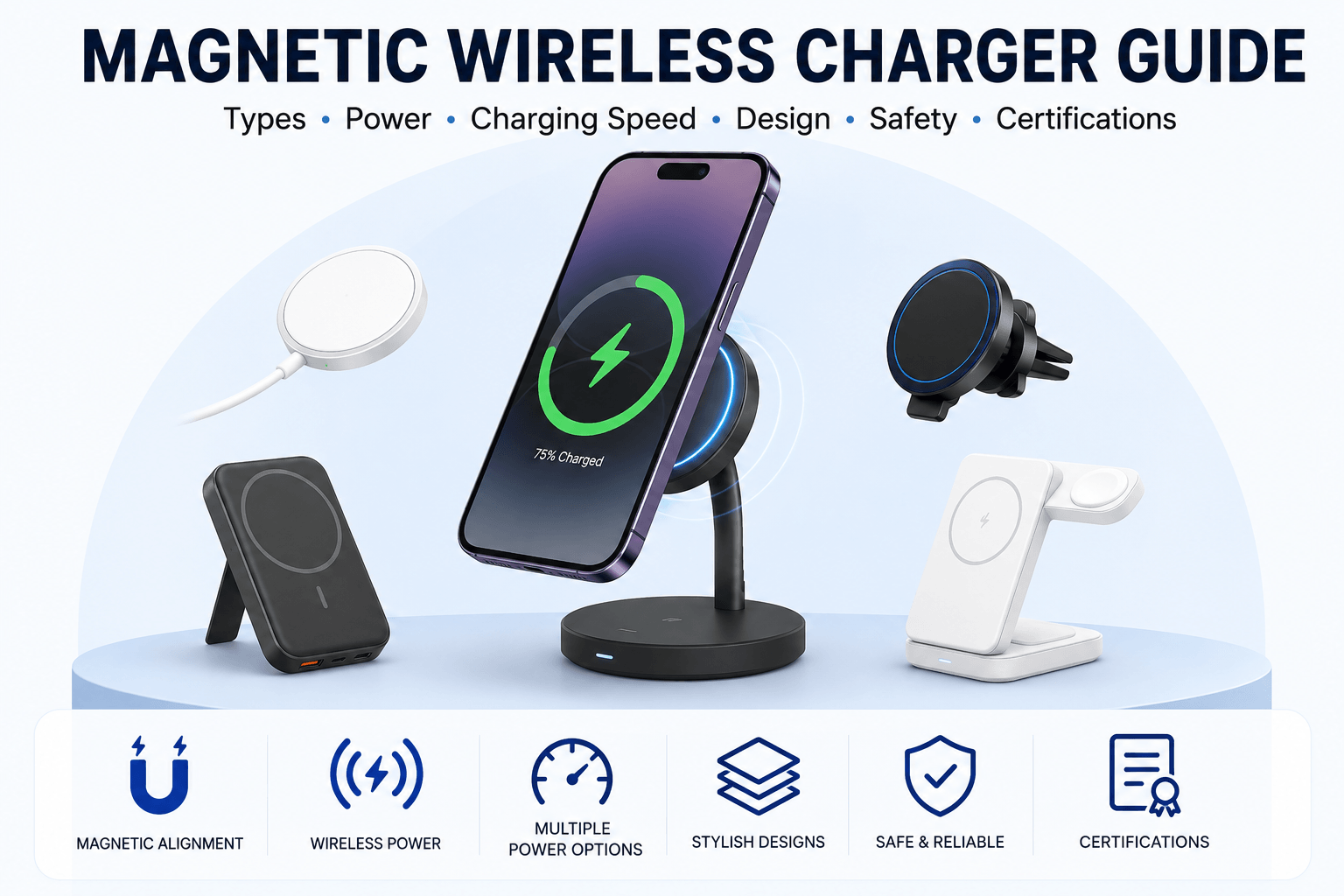
Magnetic Wireless Charger Guide: Types, Power, Charging Speed, Design, Safety and Certifications
A magnetic wireless charger looks deceptively simple. It is usually a slim charging disc, stand or charging station that attaches magnetically to the back of a compatible phone and starts charging without plugging a cable directly into the handset. Yet behind that clean, minimal design is a combination of wireless power technology, magnetic alignment, charging protocols, thermal management and safety protection.
For modern consumers, magnetic charging is attractive because it removes much of the daily inconvenience associated with cables. The charger can snap into position, remain attached while the phone is being used, and make charging feel more natural.The technology is also increasingly relevant to retailers, importers and brands. Magnetic charging products are no longer limited to a single charging disc. The market now includes magnetic charging pads, charging stands, car chargers, power banks, 2-in-1 and 3-in-1 charging stations, travel chargers and custom OEM/ODM designs.
So what makes a magnetic charger different? How does magnetic wireless charging work? What is the difference between 5W, 7.5W, 10W, 15W and 25W models? Does a higher power rating always mean faster charging? And what should buyers look for when it comes to design, compatibility and safety?
This guide covers the key points you need to know before choosing or developing a magnetic wireless charging product.
1. What Is a Magnetic Wireless Charger?
A magnetic wireless charger combines two technologies: wireless power transfer and magnetic alignment.The wireless charging system transfers energy from a transmitter coil inside the charger to a receiver coil inside the compatible device. Instead of using physical electrical contacts, the two coils exchange energy through an electromagnetic field.
The magnetic ring has a different but equally important job. It helps position the charger and receiver coils accurately.Good alignment matters because wireless charging efficiency depends heavily on the distance and relative position between the two coils.When the magnetic attachment is strong and the coils are correctly aligned, the connection remains more stable and energy transfer can be more consistent.
This is one of the major advantages of magnetic wireless charging compared with an ordinary wireless charging pad: the user does not need to repeatedly find the “sweet spot” on the charging surface.
2. How Does Magnetic Wireless Charging Work?
The process can be explained in several simple stages.First, the charger receives power from its USB-C input and converts that electricity into a controlled output for the wireless charging circuit.The transmitter electronics drive the charging coil, creating an alternating electromagnetic field.When a compatible receiver coil is placed close to the charger, energy is transferred through inductive coupling.
The receiver then converts this energy into electrical power used to charge the battery.The two devices also communicate during charging so that power can be adjusted according to the receiver’s requirements.This is why the maximum output printed on a charger should never be interpreted as the guaranteed charging speed for every phone.
The Wireless Power Consortium explains that Qi systems negotiate power between the transmitter and receiver, and that the receiver requests the amount of power appropriate for the device.
3. What Is the Difference Between Ordinary Wireless Charging and Magnetic Charging?
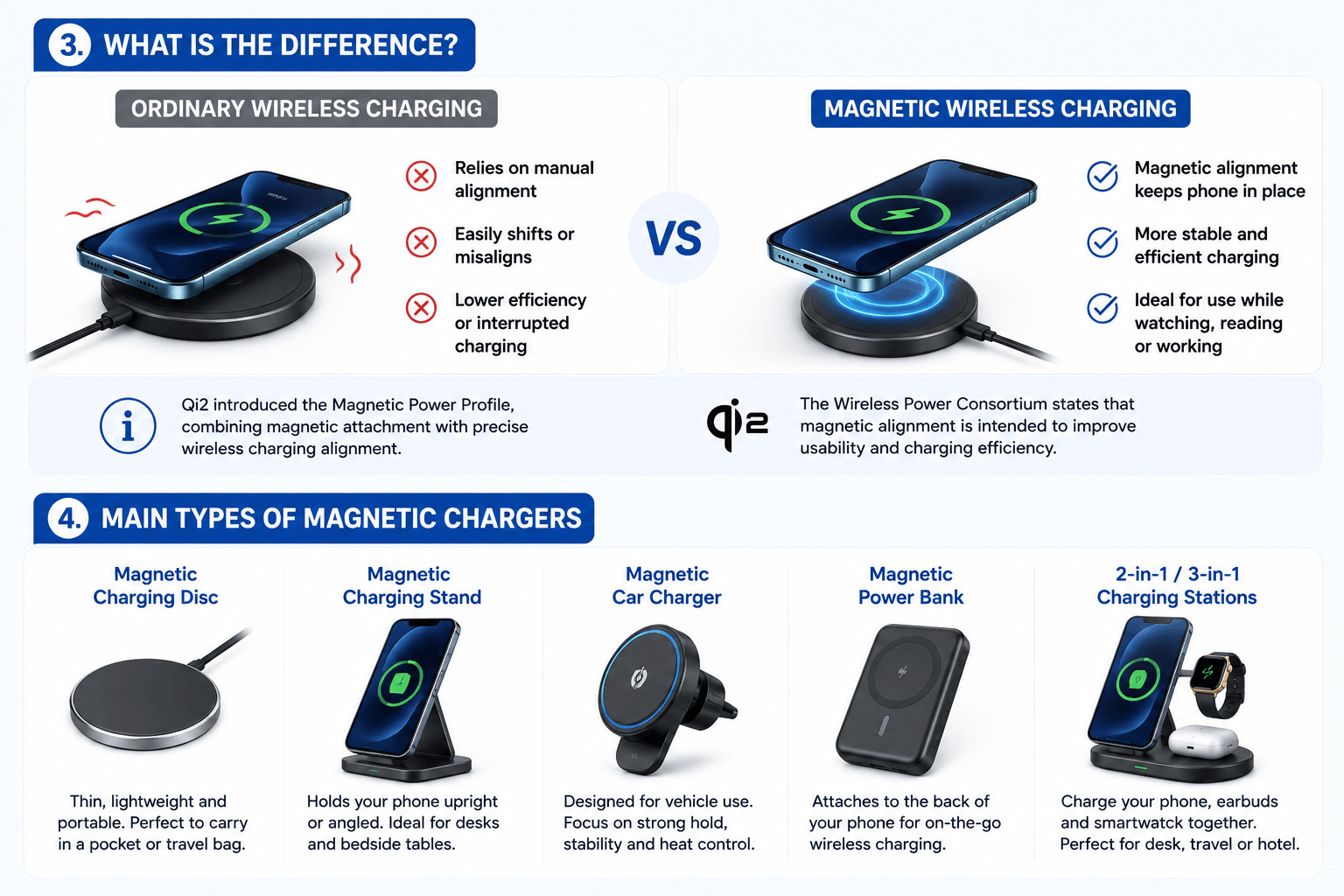
Ordinary wireless charging pads usually rely on a flat charging surface. The user places the phone on the pad and hopes the internal charging coils are correctly aligned.This works, but the phone can easily move during use. A slight shift may reduce charging efficiency or interrupt charging.Magnetic wireless chargers solve part of this problem by using a magnetic ring or magnetic alignment system to hold the device in a defined position.
The result is a charging experience that is more convenient, especially when the phone needs to remain attached while the user is watching videos, reading or working.Qi2 formally introduced the Magnetic Power Profile, combining magnetic attachment with wireless charging alignment. The Wireless Power Consortium states that the magnetic alignment is intended to improve usability and charging efficiency.
4. Main Types of Magnetic Chargers
Magnetic charging is now available in several product formats, each designed for a different situation.
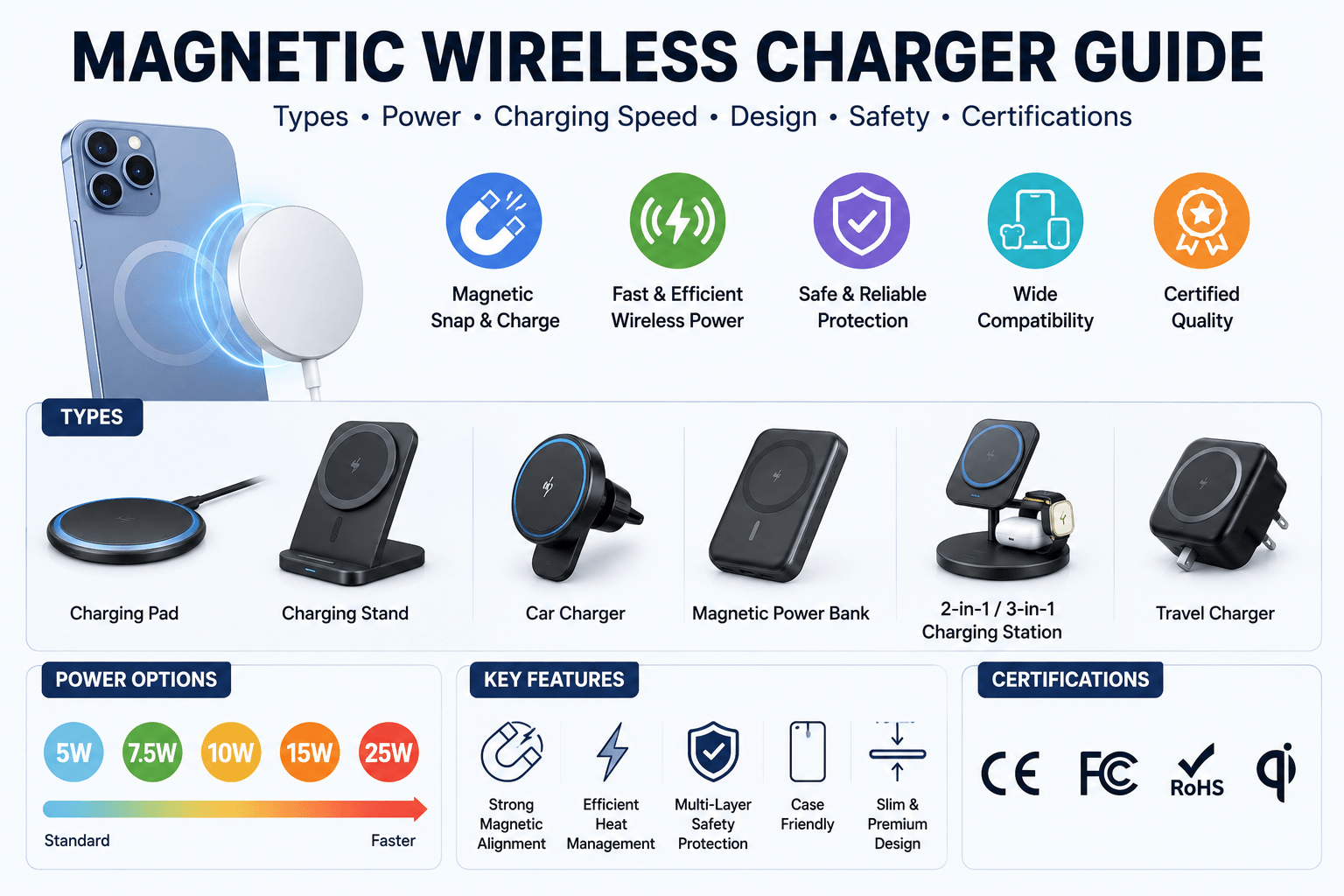
Magnetic Charging Disc:This is the simplest and most portable design. It usually consists of a thin circular charging module connected to a USB-C cable.It is ideal for users who want a charger they can carry in a pocket or keep in a small travel bag.
Magnetic Charging Stand:A magnetic charging stand supports the phone in an upright or angled position.This is particularly useful on a desk or bedside table because the screen remains visible while charging.
Magnetic Car Charger:A car charger combines magnetic attachment with a vehicle mounting system.The key considerations are magnetic strength, vibration resistance, viewing angle, heat management and cable routing.
Magnetic Power Bank:A magnetic power bank attaches directly to the back of the phone and provides portable wireless charging.This is particularly useful when the user wants to continue using the phone without dealing with a loose charging cable.
2-in-1 and 3-in-1 Magnetic Charging Stations:These products combine phone charging with separate charging positions for earbuds and smart watches.They are particularly popular for desks, bedside tables, hotels and travel.
5. Magnetic Charger Power Ratings Explained
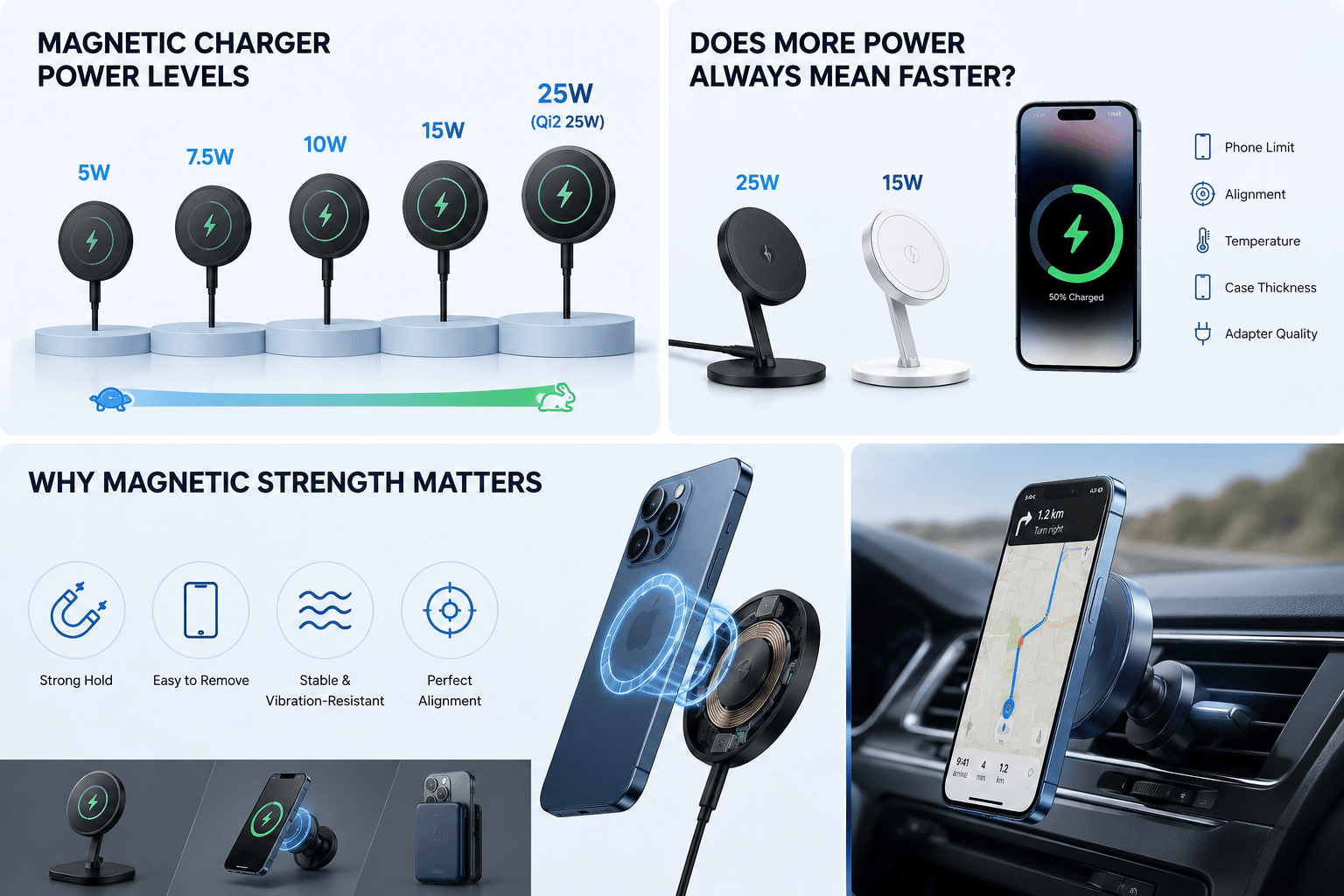
Power is one of the most important specifications when comparing magnetic chargers.Common wireless charging power levels include 5W, 7.5W, 10W, 15W and, in newer certified magnetic charging products, 25W.
5W Magnetic Charging:5W is a basic wireless charging level.It is suitable for overnight charging, smaller devices and users who are more concerned with convenience than speed.
7.5W Magnetic Charging:7.5W provides a moderate charging rate and can be suitable for everyday smartphone use where a magnetic connection is more important than maximum speed.
10W Magnetic Charging:10W provides another step up in power and may be useful for general wireless charging applications.
15W Magnetic Charging:15W has become one of the most recognisable power levels for magnetic smartphone charging.The original Qi2 magnetic power profile supports 15W, while newer Qi2 25W technology increases the maximum power level further.
25W Magnetic Charging:Qi2 25W was introduced in 2025 and is designed to provide higher-speed magnetic wireless charging. The Wireless Power Consortium says Qi2 25W delivers nearly 70% more charging power than the original Qi2 15W level, with some certified implementations achieving around 0–50% smartphone charging in about 30 minutes.
However, actual charging performance still depends on the specific phone, receiver, adapter, temperature and battery state.
6. Does More Power Always Mean Faster Charging?
Not necessarily.
A 25W magnetic charger may have a higher maximum output than a 15W model, but if the phone only accepts a lower wireless charging power, the difference may not be obvious.Wireless charging speed is also affected by coil alignment, temperature, case thickness, power conversion efficiency and the quality of the power adapter.
This is why magnetic alignment is so important. A strong magnetic connection keeps the transmitter and receiver in the correct position, helping maintain more consistent power transfer.
Qi2 was specifically designed around magnetic alignment, and the WPC highlights improved alignment and energy efficiency as major benefits of the magnetic approach.
7. Why Magnetic Strength Matters
When a magnetic charger is used as a charging pad only, the phone mainly needs to stay aligned.But when the charger is also acting as a stand, car mount or portable battery, magnetic strength becomes much more important.
A good magnetic system needs to balance several factors:
Strong enough to hold the phone securely.
Not so aggressive that the product becomes difficult to remove.
Stable enough to resist movement and vibration.
Correctly positioned around the charging coil.
For a car charger, this becomes especially critical because road vibration can place significantly more mechanical stress on the magnetic connection.
8. Magnetic Charger Design: Why Appearance Matters
Magnetic charging products are highly visible accessories. Unlike a charger hidden behind a desk, a magnetic charger often sits directly on the phone, on the dashboard or in a visible home environment.A modern magnetic charger is often designed around a slim and minimalist aesthetic.
Common design elements include:
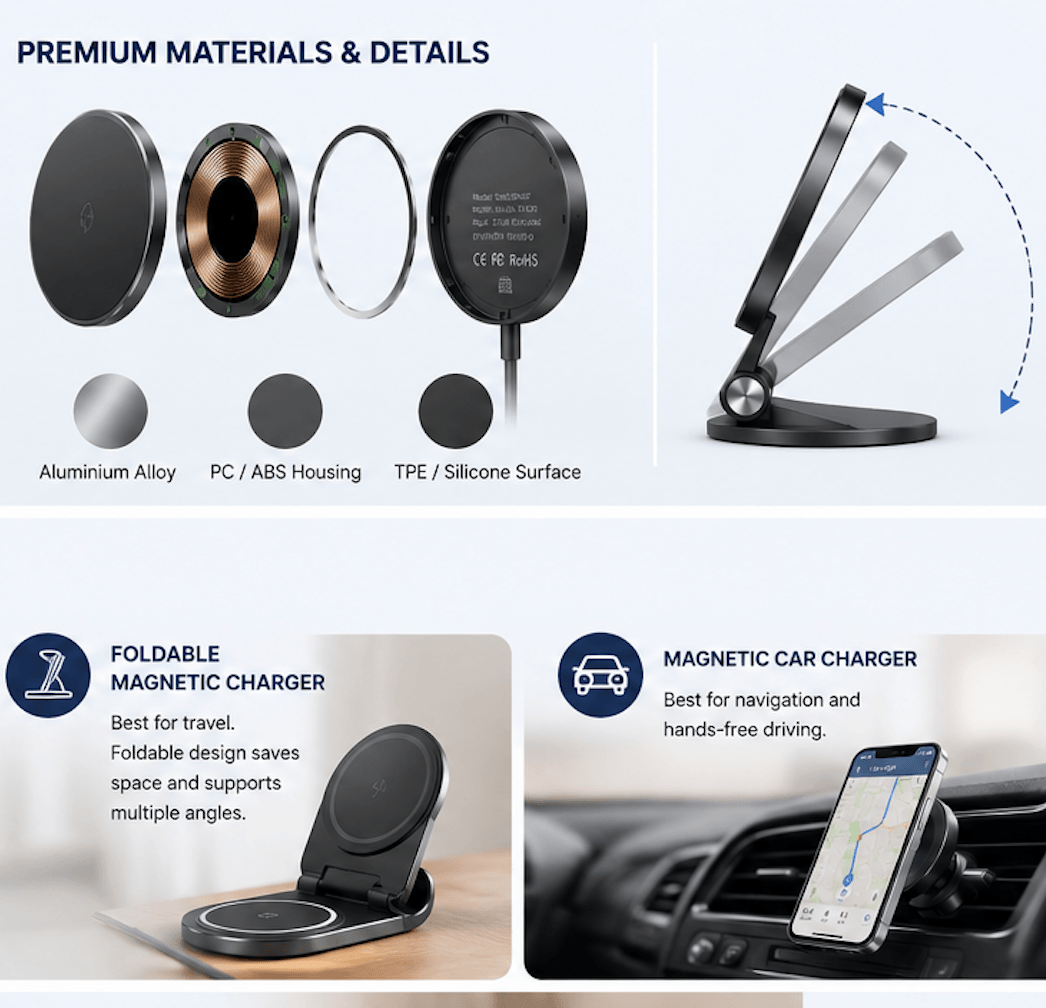
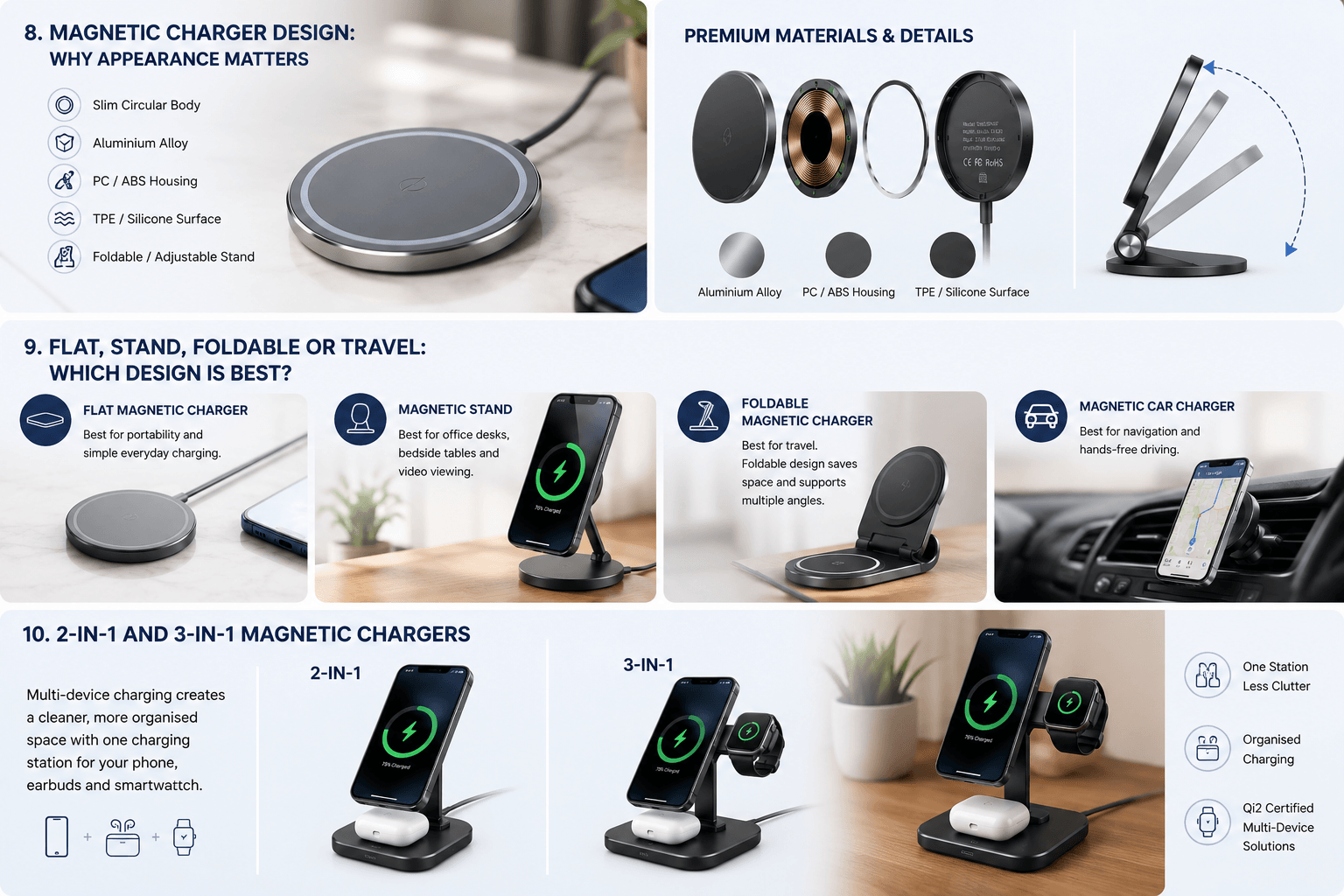
Slim circular body:A compact round body is convenient for both storage and everyday use.
Aluminium alloy:Often used for premium products because of its solid feel, appearance and ability to assist with heat dissipation.
PC or ABS housing:Suitable for lightweight products and cost-sensitive mass production.
TPE or silicone contact surface:Helps reduce scratching and can improve the grip between the charger and device.
Foldable or adjustable stands:Popular for desktop products because the viewing angle can be adjusted.
9. Flat, Stand, Foldable or Travel: Which Design Is Best?
Flat Magnetic Charger:Best for portability and simple everyday charging.It is easy to put into a pocket or travel pouch.
Magnetic Stand:Best for office desks, bedside tables and video viewing.The phone remains visible and accessible while charging.
Foldable Magnetic Charger:Best for travel.The charger can fold down to reduce its footprint and can often serve several charging positions.
Magnetic Car Charger:Best for navigation and hands-free driving.The design should prioritise stability, viewing angle, ventilation and heat management.
10. 2-in-1 and 3-in-1 Magnetic Chargers
The multi-device charging category has become an important part of the magnetic charging market.A 2-in-1 product may combine a magnetic phone charger with an earbud charging area.A 3-in-1 design can add a dedicated smartwatch charging position.This type of product is particularly attractive to people who want a cleaner desk or bedside table.
Instead of several separate cables and adapters, one charging station can create a much more organised charging area.Certified Qi2 products already appear in configurations combining magnetic phone charging with additional 5W or lower-power charging zones for other devices.
11. Safety Features Every Magnetic Charger Should Consider
Wireless charging introduces its own safety considerations because electrical energy is transferred through an electromagnetic field and heat can build up around the charging coil.A well-designed magnetic charger should consider at least the following protections.
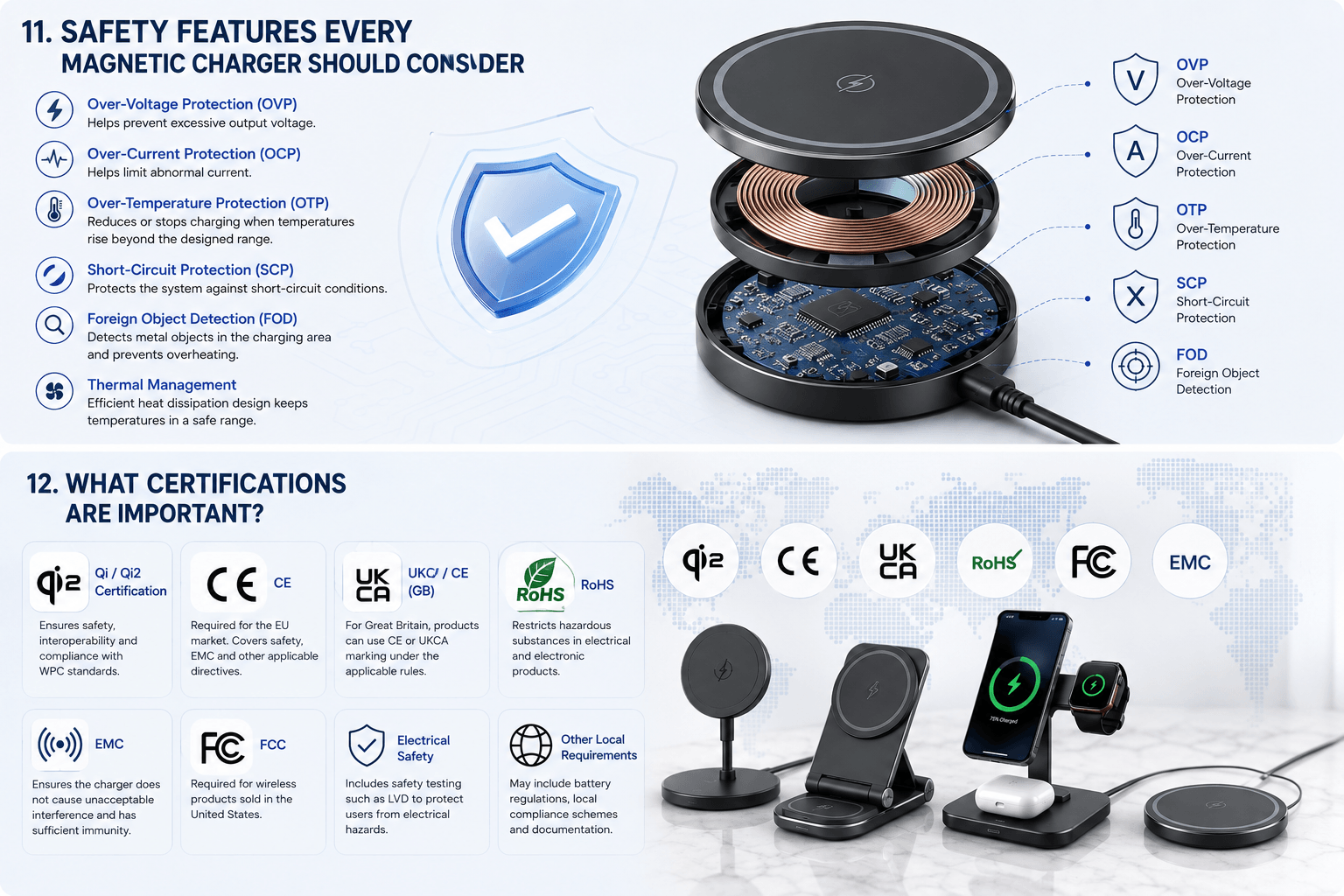
Over-Voltage Protection (OVP):Helps prevent excessive output voltage.
Over-Current Protection (OCP):Helps limit abnormal current.
Over-Temperature Protection (OTP):Reduces or stops charging when temperatures rise beyond the designed range.
Short-Circuit Protection (SCP):Protects the system against short-circuit conditions.
Foreign Object Detection (FOD):This is particularly important for wireless charging. Metal objects placed in the charging area can cause unwanted heating.Qi specifications include foreign-object detection requirements and testing designed to identify unwanted metallic objects around the charging area.
Thermal Management:The charger should be designed to manage heat generated by the power electronics and wireless charging coil.The housing material, internal structure, coil design and PCB layout can all influence thermal performance.
12. What Certifications Are Important?
For magnetic wireless chargers sold internationally, product compliance should be considered early in the design process rather than after production is complete.
Qi / Qi2 Certification:Qi certification is highly relevant to wireless charging products.Products that are officially Qi Certified are tested by authorised independent laboratories for safety and interoperability. The WPC states that only certified products may display the Qi or Qi2 logo.For buyers, this is important because “Qi compatible”, “works with Qi” and “Qi Certified” should not automatically be treated as the same thing.
CE:For products placed on the EU market, CE conformity requirements depend on the product and the applicable legislation.A magnetic wireless charger may involve requirements relating to electrical safety, electromagnetic compatibility and, depending on its features, other applicable legislation.
UKCA and CE for Great Britain:For Great Britain, the Electrical Equipment (Safety) Regulations 2016 establish safety requirements for applicable electrical equipment. Current UK government guidance confirms that qualifying products may, under the applicable rules, be placed on the GB market using CE or UKCA marking.Manufacturers also need to consider electromagnetic compatibility requirements under the EMC Regulations 2016.
RoHS:RoHS requirements restrict certain hazardous substances in electrical and electronic products and are particularly relevant when selling into European markets.
EMC:A wireless charger should not create unacceptable electromagnetic interference, and it should also have an appropriate level of immunity to interference in its intended environment. UK guidance explicitly identifies these as essential EMC requirements.
Other Market-Specific Requirements:Depending on the destination market, buyers may also need to consider requirements and certifications such as FCC, UK product safety documentation, electrical safety testing, battery regulations for magnetic power banks, or other local schemes.The exact certification route should always be confirmed against the final product specification and target market.
13. What Should Importers and Brands Check Before Ordering?
A product may look impressive in a sample photo, but the details behind the product determine whether it can be sold successfully at scale.
Before placing an OEM or ODM order, buyers should check:
Magnetic strength — Is the attachment secure enough for the intended use?
Charging power — Is the stated power actually supported by the complete system?
Charging protocol — What standard or protocol does the product support?
Coil alignment — Is the magnetic ring correctly aligned with the wireless charging coil?
Thermal performance — Does the product maintain stable operation under sustained charging?
Cable quality — What wire, connector and cable specifications are being used?
Safety protection — Are OVP, OCP, OTP, SCP and FOD implemented where appropriate?
Certification — Is the exact production model covered by the stated certification?
This last point is especially important. A certification document should not simply be associated with a visually similar product. The WPC advises buyers to verify Qi certification through its database and check that the certificate information corresponds to the actual product.
14. The Role of Materials in Magnetic Charger Quality
Two magnetic chargers can look almost identical on the outside while having very different internal quality.Materials affect durability, heat dissipation, weight, appearance and user experience.Aluminium alloy can provide a premium feel and support heat spreading. ABS and PC can help create lightweight products with good impact resistance. Silicone and TPE can improve grip and help protect the device surface.
The internal magnet structure also matters. The magnetic ring must be positioned accurately and assembled consistently.For a brand selling premium magnetic chargers, these details can make a major difference in customer perception.
15. Why Magnetic Charging Is More Than a Charging Feature
One of the most interesting developments in the market is that magnetic charging is becoming part of a wider accessory ecosystem.The same magnetic interface can support charging stands, car mounts, battery packs, wallets, grips, desk accessories and other attachable products.This creates new opportunities for brands.
Instead of selling a single charger, a company can develop an entire range of magnetic accessories built around a consistent visual language and mechanical system.For OEM/ODM buyers, this can be particularly valuable because one magnetic platform can potentially support several products and accessories.

16. The Future of Magnetic Charging
Magnetic wireless charging is moving towards higher efficiency, higher power, more compact designs and broader accessory compatibility.Qi2 introduced magnetic alignment as a major part of the standard, while Qi2 25W has now increased the available power level further. The WPC says the newer Qi2 25W specification can deliver nearly 70% more power than the original Qi2 15W level.
This does not mean every phone will immediately charge at 25W. Compatibility remains dependent on the phone, receiver and certified implementation.The broader direction is clear: charging is becoming more integrated, more convenient and less dependent on physical connectors.
For consumers, that means simpler daily charging.For brands, it means more opportunities to build differentiated products around magnetic attachment, portable charging and multi-device charging.
Conclusion: What Makes a Good Magnetic Charger?
A good magnetic charger is not simply a charger with a strong magnet.It needs a well-designed wireless charging system, reliable magnetic alignment, stable power delivery, efficient thermal management, appropriate safety protection and compliance with the requirements of its target market.
For everyday users, the right product depends on how the charger will be used. A slim 5W or 7.5W charger may be enough for overnight charging, while a 15W or newer 25W magnetic charger can be more attractive to users who prioritise faster charging.
For desks, a stand may be more useful. For travel, portability matters more. For the car, magnetic strength and stability become critical. For households with several devices, a 2-in-1 or 3-in-1 charging station may offer the best overall experience.
For retailers and brands, however, product development goes much further than choosing a wattage number. Magnet structure, coil design, PCB quality, materials, charging protocols, thermal performance, cable selection, testing and certification all influence the finished product.
The best magnetic charger is therefore not simply the fastest one. It is the product that combines reliable magnetic alignment, suitable charging power, efficient wireless power transfer, attractive design, strong safety protection and market compliance into one coherent product.
For OEM and ODM projects, this balance becomes even more important. A successful magnetic charging product needs not only a good appearance, but also consistent production quality, dependable performance and a design that can stand up to real-world daily use.



Leave a Reply