 Get 30% Off On Selected Items
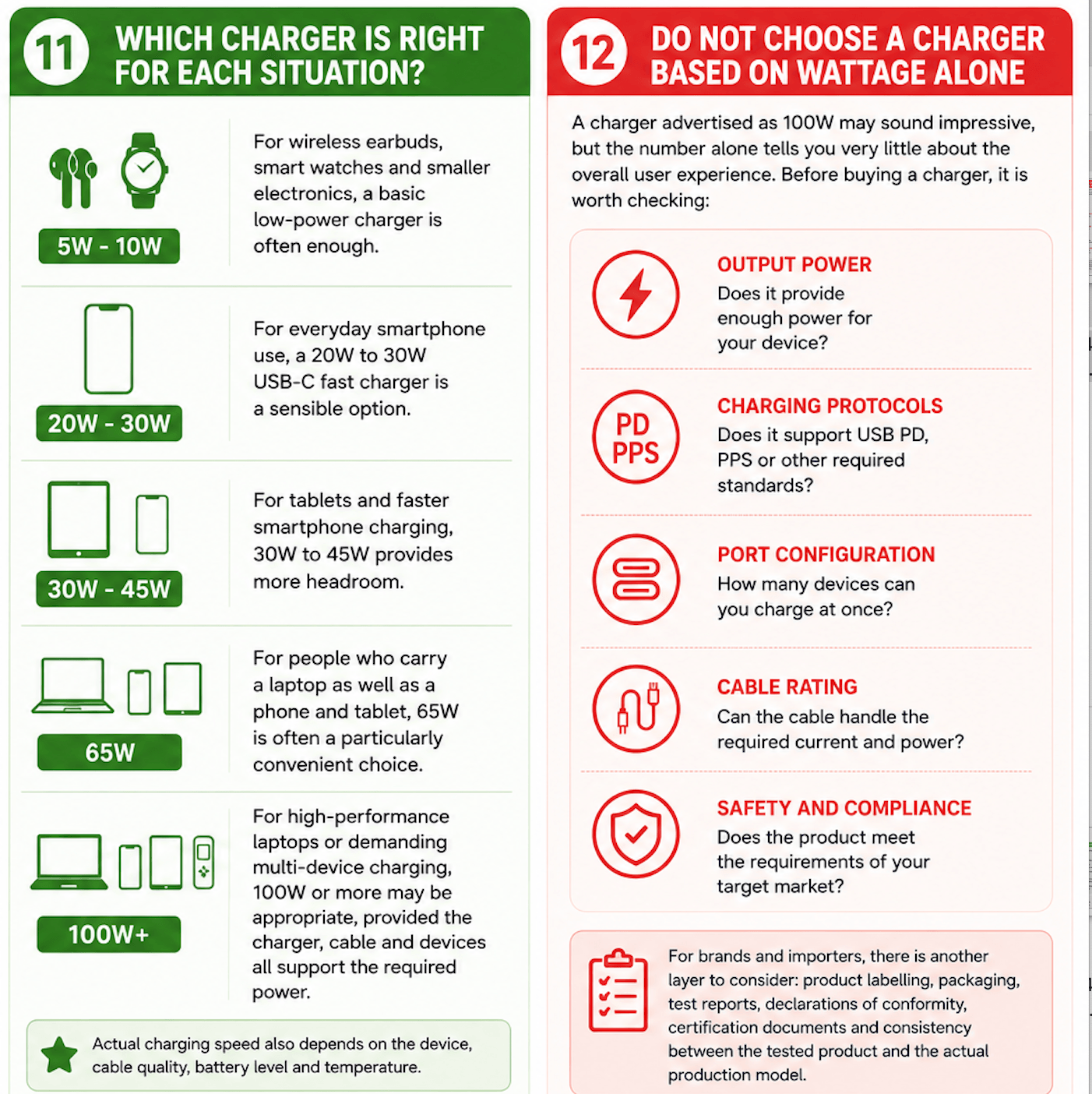

Charger Guide: Types, Power Ratings, Charging Speeds, USB-C, Cables and Safety Certifications
Choosing a charger should be simple. Yet once you start comparing 20W, 30W, 45W, 65W, 100W, USB-C, PD, PPS, GaN and fast-charging cables, it can quickly become difficult to know what actually matters.
A good charger is not simply the one with the highest wattage. The right choice depends on the device you are charging, the charging protocol it supports, the cable you use, how many devices you need to charge at once, and the safety standards required in your market.
For everyday users, understanding these basics can help you charge more quickly and safely. For retailers, importers and brands, understanding them is even more important when choosing reliable charging products or developing an OEM/ODM solution.
1. How Does a Charger Work?
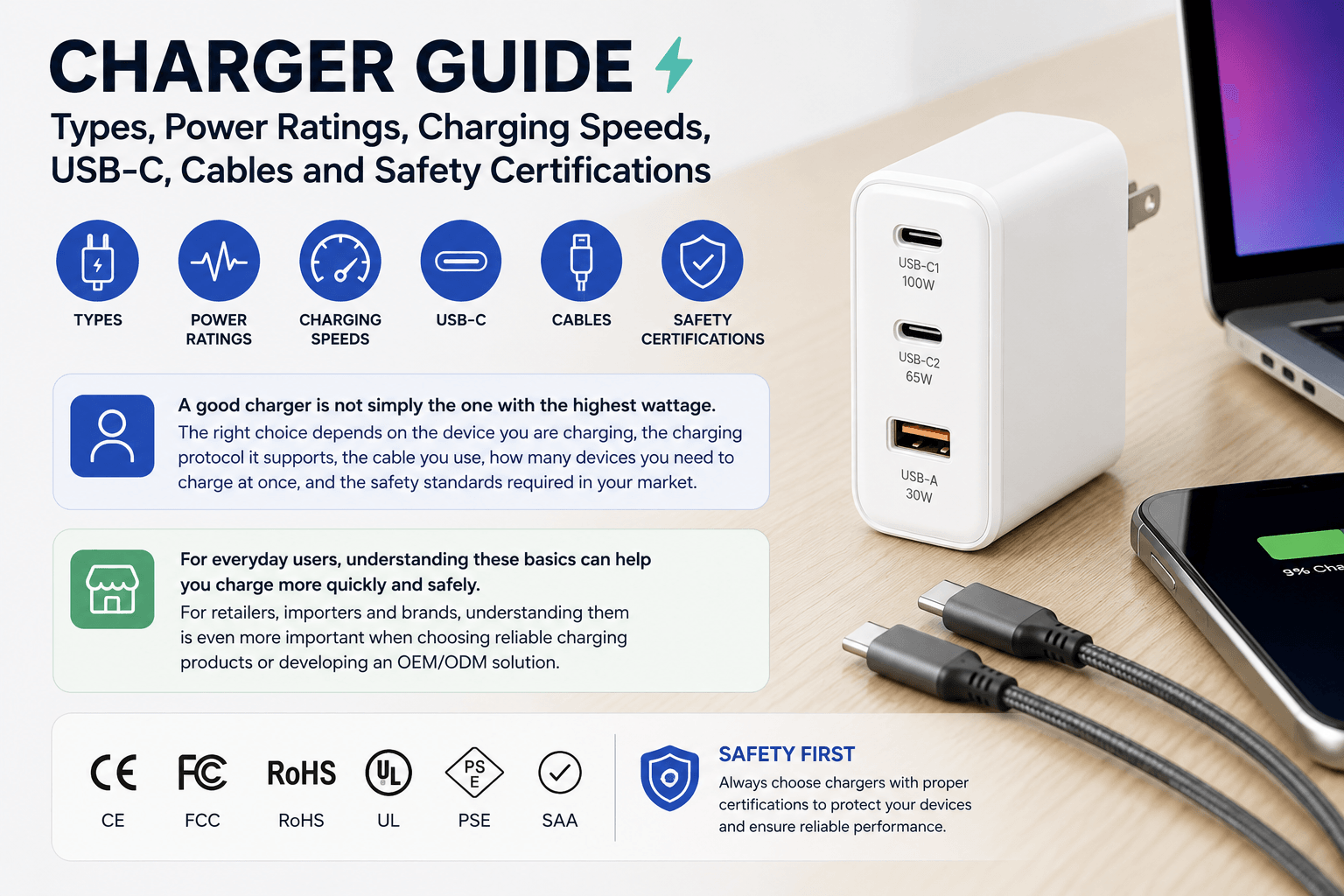
A mains socket supplies high-voltage alternating current, or AC. Your phone, tablet, earbuds and laptop battery, however, need controlled low-voltage direct current, or DC. The charger converts the electricity from the mains into a form that your electronic device can safely use.
Inside a modern charger, several stages work together, including rectification, switching, voltage conversion, filtering and output regulation. The charger continuously controls its output so that the connected device receives suitable voltage and current.
Modern fast chargers can also communicate with compatible devices. For example, USB Power Delivery, commonly known as USB PD, allows the charger and device to negotiate a suitable charging level instead of simply delivering maximum power all the time.
This is why a 100W charger does not automatically charge every device at 100W. The actual charging speed depends on the charger, the device, the cable, the charging protocol, the battery temperature and the current battery level.
2. Common Types of Chargers
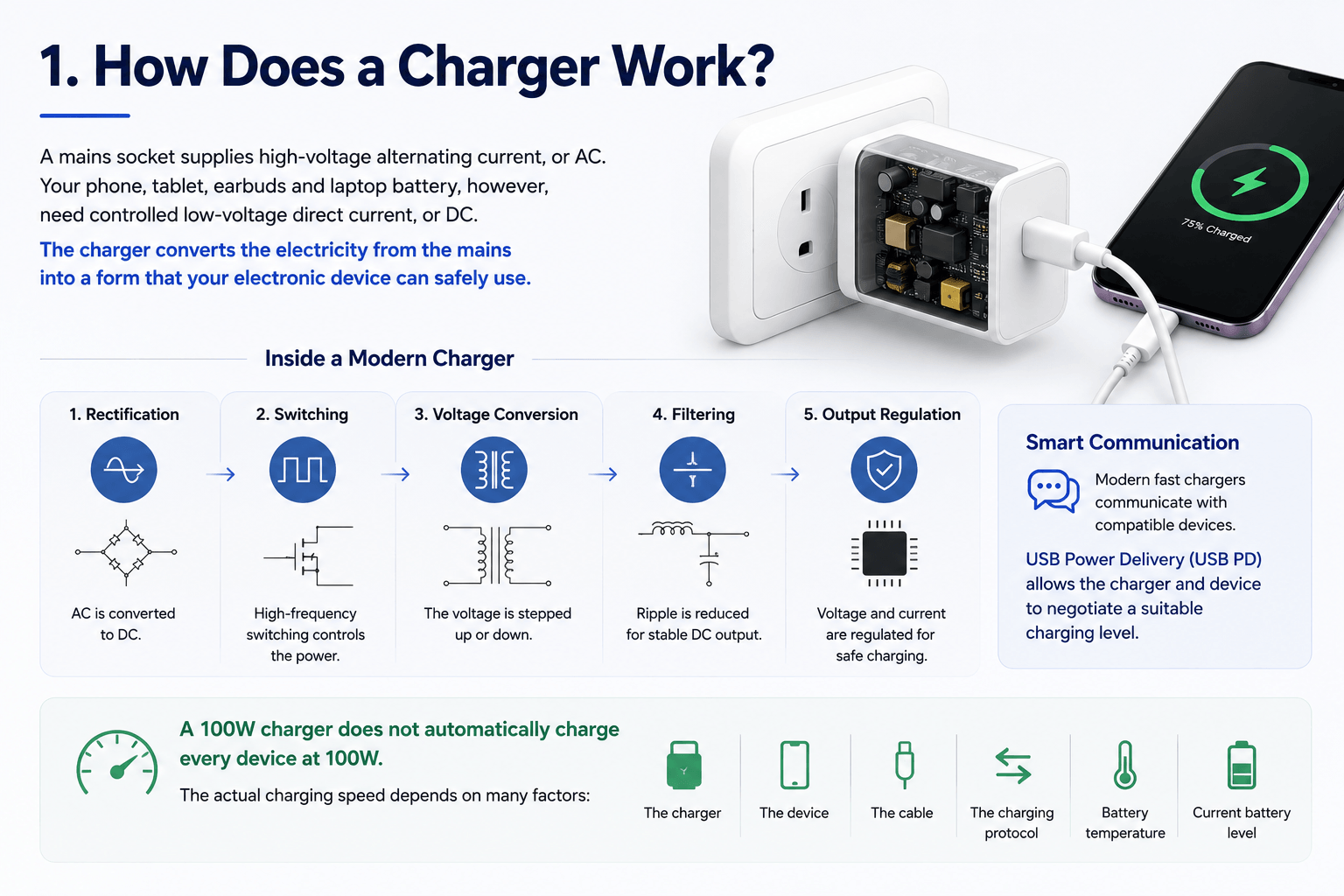
Traditional USB chargers generally offer relatively low power, often around 5W to 12W. They are suitable for smaller devices such as wireless earbuds, smart watches and some older smartphones.Their main advantages are simplicity, compatibility and low cost. The trade-off is slower charging compared with modern fast chargers.
For many users, a 20W USB-C charger offers a good balance between charging speed, size and price. It is compact enough for everyday use and travel, while providing significantly faster charging than basic 5W adapters.
30W, 33W, 40W and 45W chargers are suitable for users who want faster charging for phones and tablets. Depending on the device, they can also support certain handheld gaming devices and lightweight laptops.These chargers are especially useful when you want a little more headroom than a standard smartphone charger without carrying a larger laptop power brick.
It can provide fast charging for many smartphones and tablets while also supplying enough power for a range of lightweight laptops.For commuters, students, business travellers and remote workers, a single 65W USB-C charger can often replace several separate chargers.
Higher-power chargers, such as 100W, 120W and 140W models, are designed for more demanding equipment and multi-device charging.They are commonly used for performance laptops, larger tablets, gaming devices and demanding mobile workstations.However, higher wattage does not automatically mean faster charging. The device itself must support the required charging power.
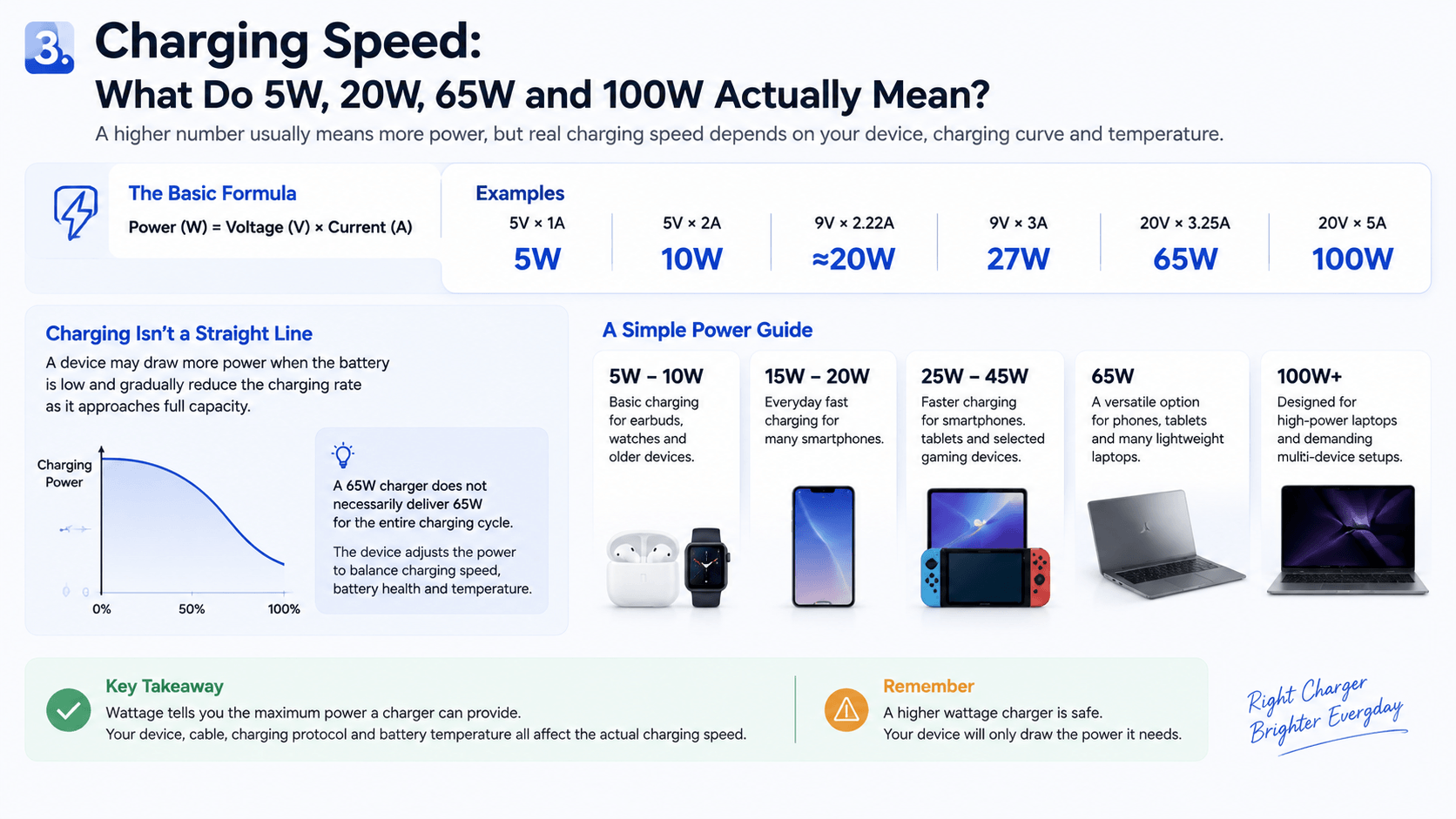
3. Charging Speed: What Do 5W, 20W, 65W and 100W Actually Mean?
The basic relationship is straightforward: Power (W) = Voltage (V) × Current (A)
For example: 5V × 1A = 5W 5V × 2A = 10W 9V × 2.22A ≈ 20W 9V × 3A = 27W 20V × 3.25A = 65W 20V × 5A = 100W
In real-world use, however, charging is not a constant straight line. A phone may draw more power when the battery is low and gradually reduce the charging rate as the battery approaches full capacity.This means that a 65W charger does not necessarily deliver 65W for the entire charging cycle. The device adjusts the power to balance charging speed, battery health and temperature.
A Simple Power Guide:
5W–10W: Basic charging for earbuds, watches and older devices.
15W–20W: Everyday fast charging for many smartphones.
25W–45W: Faster charging for smartphones, tablets and selected gaming devices.
65W: A versatile option for phones, tablets and many lightweight laptops.
100W+: Designed for high-power laptops and demanding multi-device setups.
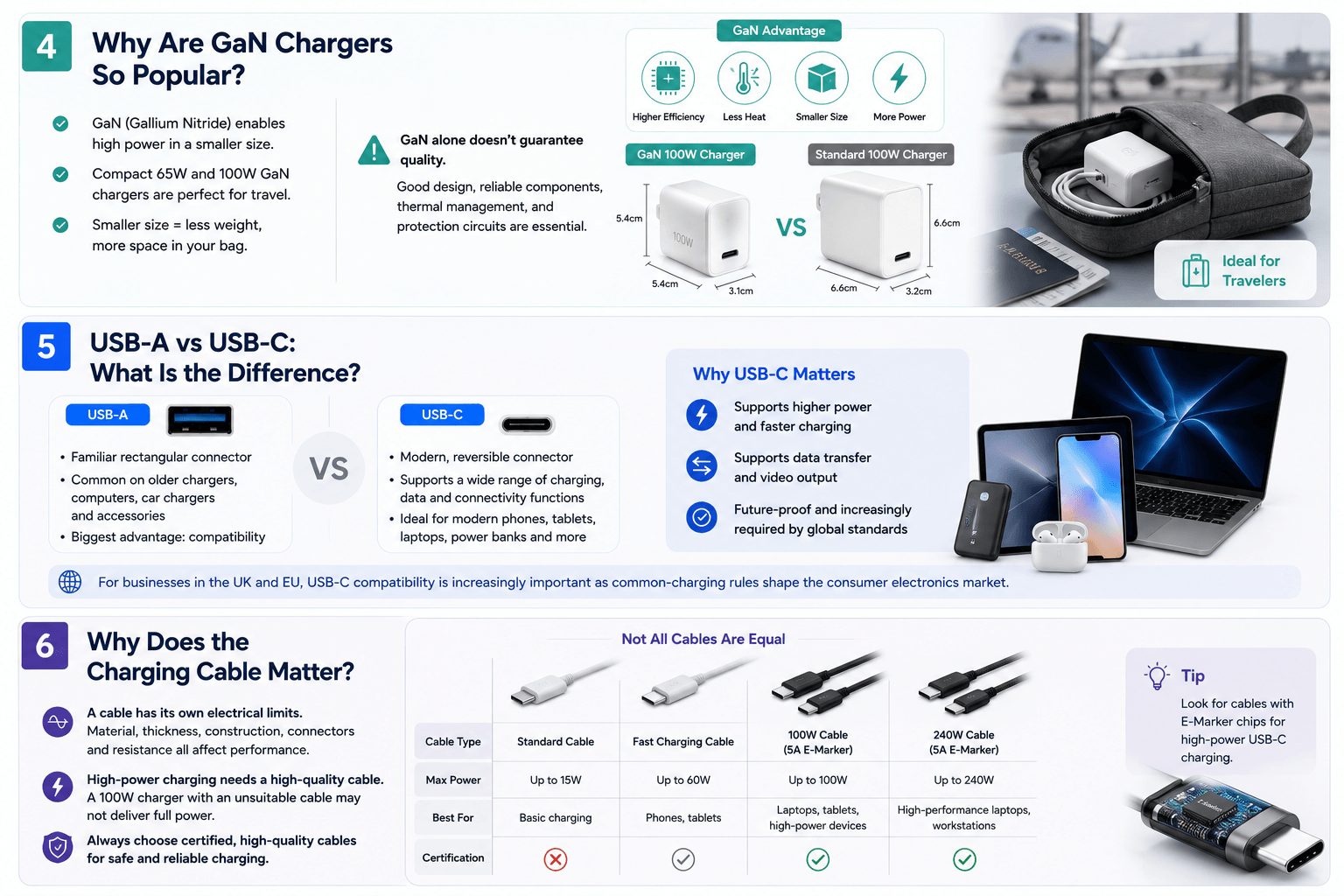
4. Why Are GaN Chargers So Popular?
GaN stands for Gallium Nitride, a semiconductor material increasingly used in modern power electronics.One of the key advantages of GaN technology is that it can help manufacturers achieve high power density in a relatively compact design.This is why compact 65W and 100W GaN chargers are becoming increasingly common.For travellers, this matters a great deal. A smaller charger means less weight in your bag and fewer bulky adapters to carry around.
However, GaN alone does not guarantee a high-quality charger. Good PCB design, reliable components, thermal management and proper protection circuits remain essential.
5. USB-A vs USB-C: What Is the Difference?
USB-A is the familiar rectangular USB connector that has been used for many years.It remains common on older chargers, computers, car chargers and various accessories.Its biggest advantage is compatibility, although USB-C has become increasingly important for modern fast charging.
USB-C has become the preferred connector for modern charging, particularly for fast charging and higher-power applications.Unlike the older USB-A connector, USB-C is designed to support a wide range of charging, data and connectivity functions.This makes USB-C particularly suitable for modern phones, tablets, laptops, power banks and other portable electronics.
For businesses selling into the UK and European markets, USB-C compatibility is increasingly important as common-charging rules continue to shape the consumer electronics market.
6. Why Does the Charging Cable Matter?
One of the most common mistakes is buying a high-power charger but using a cable that cannot handle the same level of power.A charging cable has its own electrical limits. The conductor material, wire thickness, internal construction, connector quality and overall resistance can all affect performance.
This is especially important for higher-power USB-C charging.A 100W charger paired with an unsuitable cable may not allow the connected laptop or device to receive its full supported power.
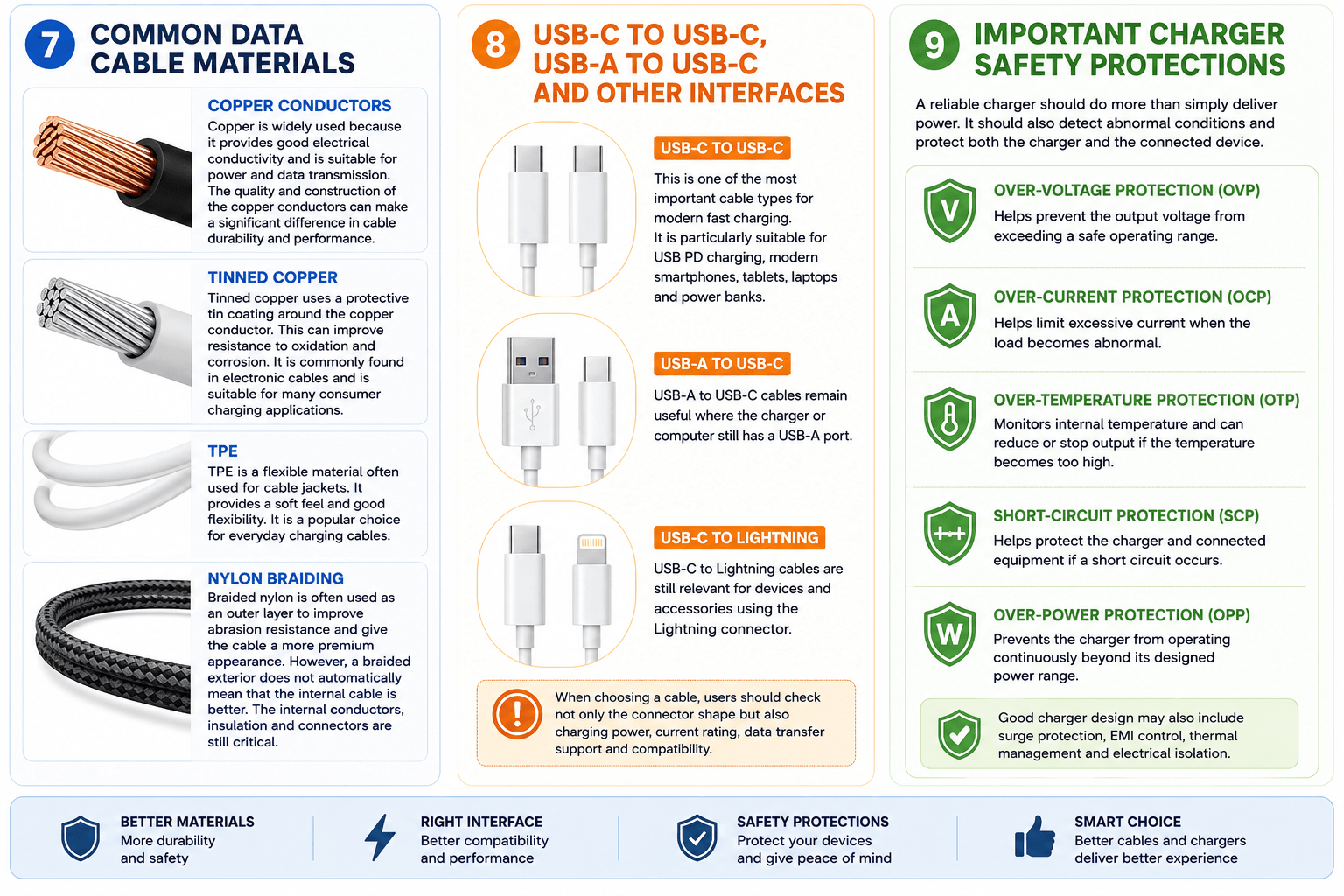
7. Common Data Cable Materials
Copper Conductors:Copper is widely used because it provides good electrical conductivity and is suitable for power and data transmission.The quality and construction of the copper conductors can make a significant difference in cable durability and performance.
Tinned Copper:Tinned copper uses a protective tin coating around the copper conductor. This can improve resistance to oxidation and corrosion.It is commonly found in electronic cables and is suitable for many consumer charging applications.
TPE:TPE is a flexible material often used for cable jackets. It provides a soft feel and good flexibility.It is a popular choice for everyday charging cables.
Nylon Braiding:Braided nylon is often used as an outer layer to improve abrasion resistance and give the cable a more premium appearance.However, a braided exterior does not automatically mean that the internal cable is better. The internal conductors, insulation and connectors are still critical.
8. USB-C to USB-C, USB-A to USB-C and Other Interfaces
This is one of the most important cable types for modern fast charging.It is particularly suitable for USB PD charging, modern smartphones, tablets, laptops and power banks.
USB-A to USB-C cables remain useful where the charger or computer still has a USB-A port.
USB-C to Lightning cables are still relevant for devices and accessories using the Lightning connector.When choosing a cable, users should check not only the connector shape but also charging power, current rating, data transfer support and compatibility.
9. Important Charger Safety Protections
A reliable charger should do more than simply deliver power. It should also detect abnormal conditions and protect both the charger and the connected device.
Over-Voltage Protection (OVP):Helps prevent the output voltage from exceeding a safe operating range.
Over-Current Protection (OCP):Helps limit excessive current when the load becomes abnormal.
Over-Temperature Protection (OTP):Monitors internal temperature and can reduce or stop output if the temperature becomes too high.
Short-Circuit Protection (SCP):Helps protect the charger and connected equipment if a short circuit occurs.
Over-Power Protection (OPP):Prevents the charger from operating continuously beyond its designed power range.Good charger design may also include surge protection, EMI control, thermal management and electrical isolation.
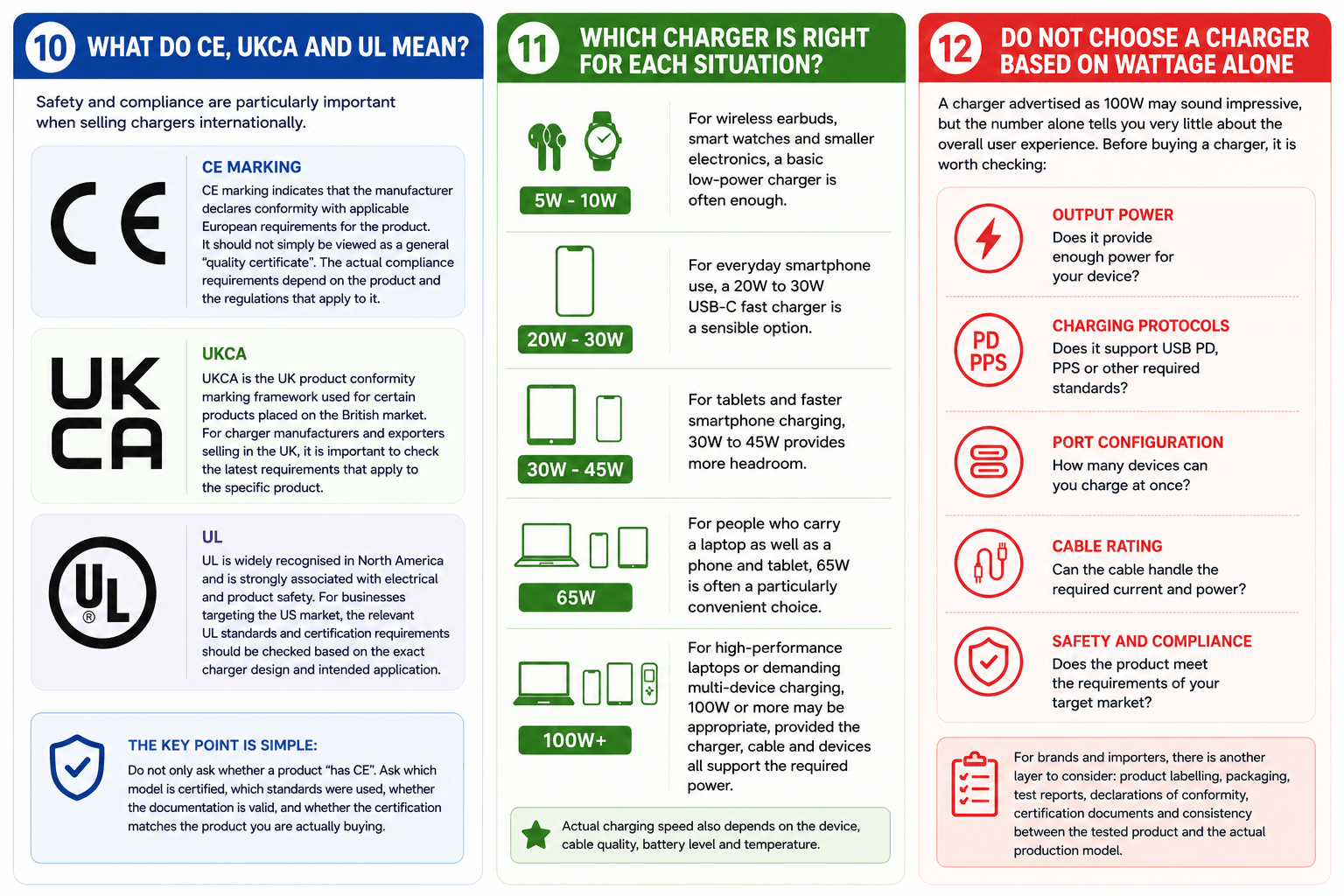
10. What Do CE, UKCA and UL Mean?
Safety and compliance are particularly important when selling chargers internationally.
CE Marking:CE marking indicates that the manufacturer declares conformity with applicable European requirements for the product.It should not simply be viewed as a general “quality certificate”. The actual compliance requirements depend on the product and the regulations that apply to it.
UKCA:UKCA is the UK product conformity marking framework used for certain products placed on the British market.For charger manufacturers and exporters selling in the UK, it is important to check the latest requirements that apply to the specific product.
UL:UL is widely recognised in North America and is strongly associated with electrical and product safety.For businesses targeting the US market, the relevant UL standards and certification requirements should be checked based on the exact charger design and intended application.
The key point is simple: do not only ask whether a product “has CE”. Ask which model is certified, which standards were used, whether the documentation is valid, and whether the certification matches the product you are actually buying.
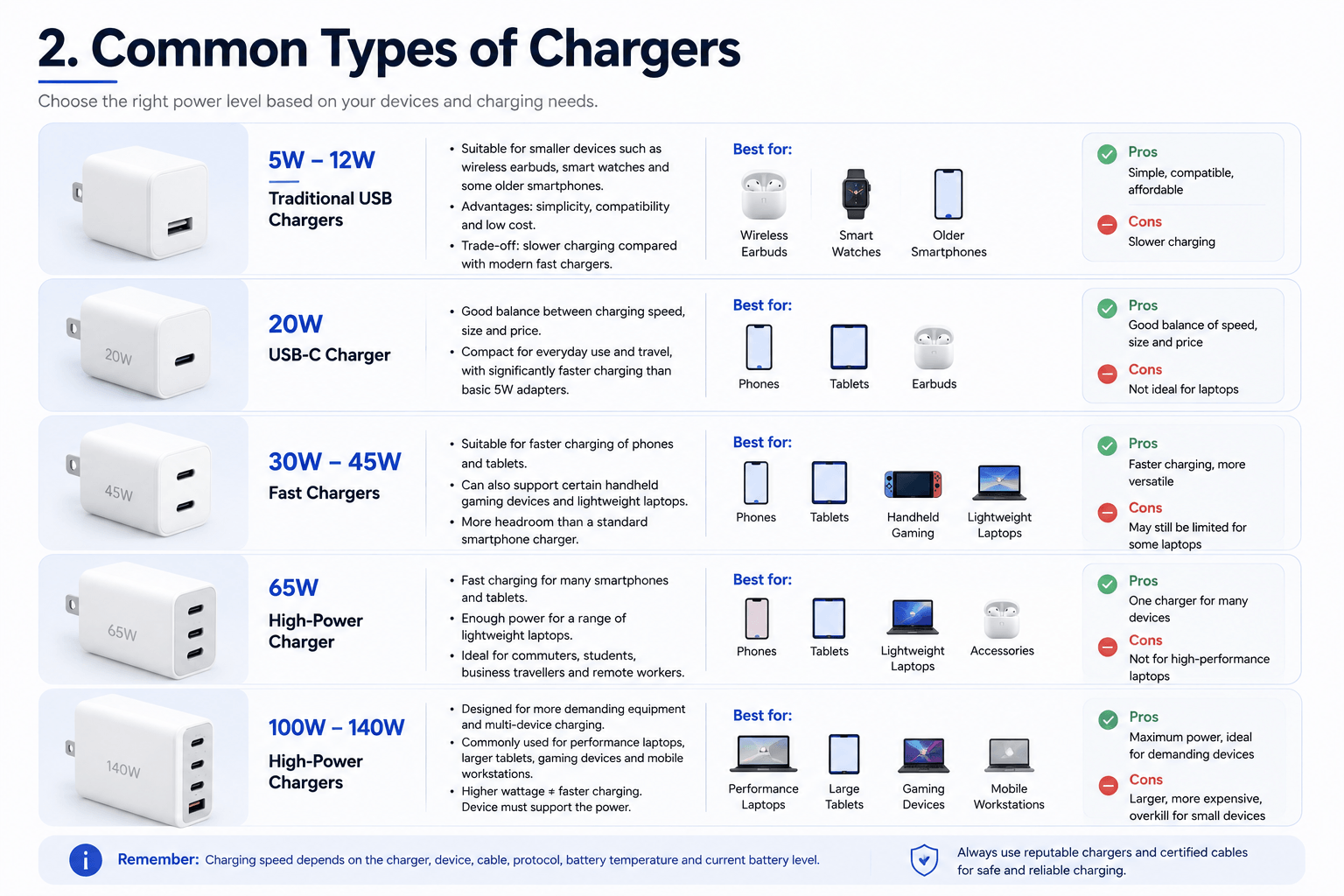
11. Which Charger Is Right for Each Situation?
For wireless earbuds, smart watches and smaller electronics, a basic low-power charger is often enough.For everyday smartphone use, a 20W to 30W USB-C fast charger is a sensible option.For tablets and faster smartphone charging, 30W to 45W provides more headroom.For people who carry a laptop as well as a phone and tablet, 65W is often a particularly convenient choice.For high-performance laptops or demanding multi-device charging, 100W or more may be appropriate, provided the charger, cable and devices all support the required power.
12. Do Not Choose a Charger Based on Wattage Alone
A charger advertised as 100W may sound impressive, but the number alone tells you very little about the overall user experience.Before buying a charger, it is worth checking:
Output power — Does it provide enough power for your device?
Charging protocols — Does it support USB PD, PPS or other required standards?
Port configuration — How many devices can you charge at once?
Cable rating — Can the cable handle the required current and power?
Safety and compliance — Does the product meet the requirements of your target market?
For brands and importers, there is another layer to consider: product labelling, packaging, test reports, declarations of conformity, certification documents and consistency between the tested product and the actual production model.
13. The Future of Charging: Smaller, Faster and More Versatile
The charging industry is moving away from the idea of one charger for one device.Instead, consumers increasingly want one compact charger that can power a phone, tablet, laptop, earbuds and other accessories.USB-C, USB Power Delivery, GaN technology and higher-power cables are all contributing to this shift.For consumers, this means fewer chargers, less weight and greater convenience.
For brands and retailers, it creates opportunities to develop compact fast chargers, multi-port charging stations, travel charging solutions and custom OEM/ODM products for different markets.The ideal charger is not necessarily the most powerful charger available. It is the one that offers the right balance of power, compatibility, size, efficiency, cable performance, safety and compliance.




Leave a Reply