 Get 30% Off On Selected Items

Can You Still Use a Power Bank After Leaving It Unused for a Year? A Complete Guide to Long-Term Storage, Battery Ageing and Fire Risks
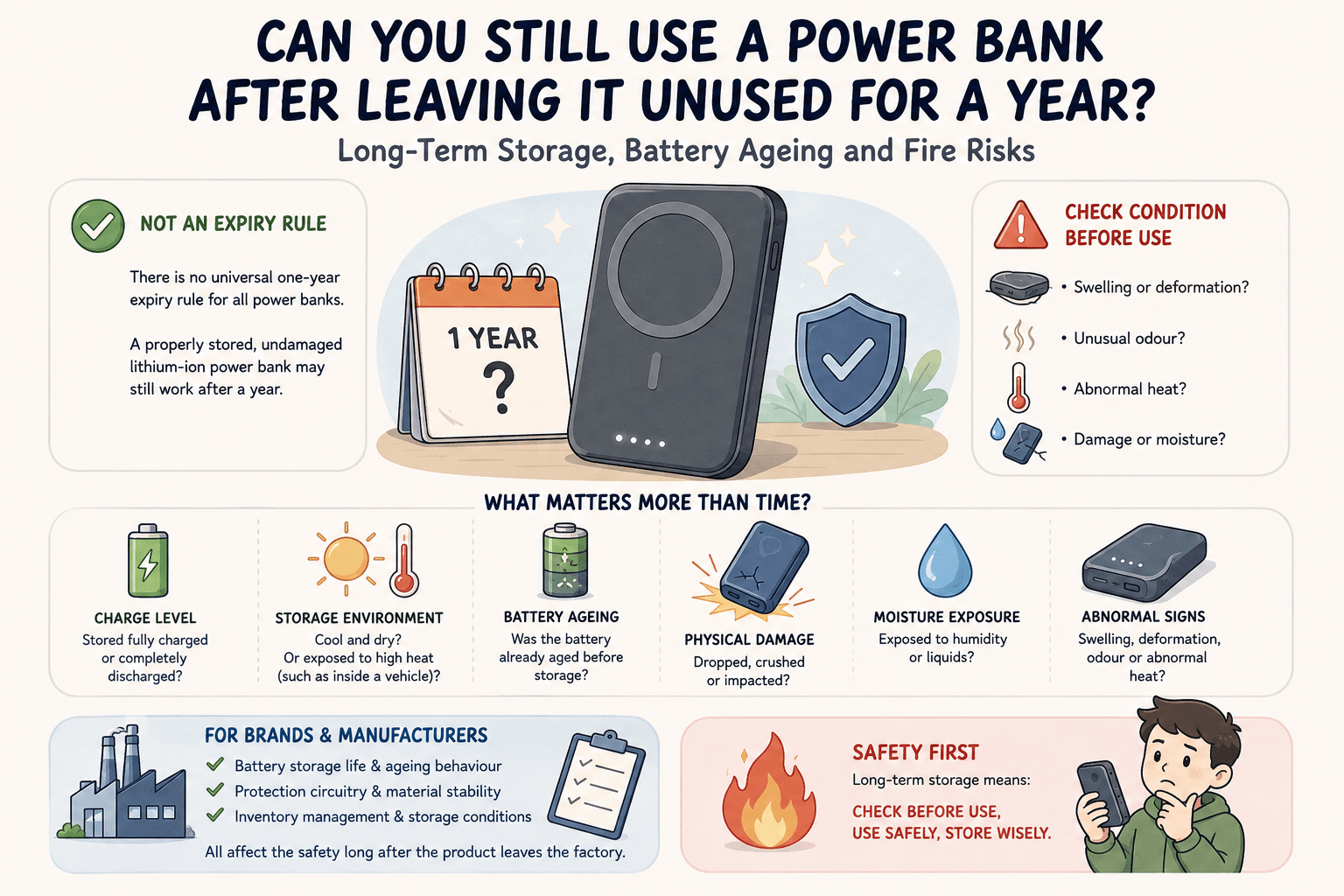
The idea that a power bank automatically becomes unsafe after one year of non-use is too simplistic.There is no universal one-year expiry rule for all power banks. A properly manufactured lithium-ion power bank that has been stored under suitable conditions and has not suffered damage may still function after a year of inactivity.The more important question is what happened to the battery during that period.
Was it stored fully charged or completely discharged?
Was it kept in a cool, dry environment or exposed to high temperatures inside a vehicle?
Had the battery already aged before storage?
Was the device dropped, crushed or exposed to moisture?
Has it developed swelling, deformation, unusual odours or abnormal heat?
These factors are more important than the calendar alone.For consumers, long-term storage means a power bank should not simply be plugged in and used without checking its condition.For manufacturers and brands, the issue is even broader. Battery storage life, ageing behaviour, protection circuitry, material stability and inventory management all influence the safety of the product after it leaves the factory.
Does Long-Term Storage Really Age a Power Bank?
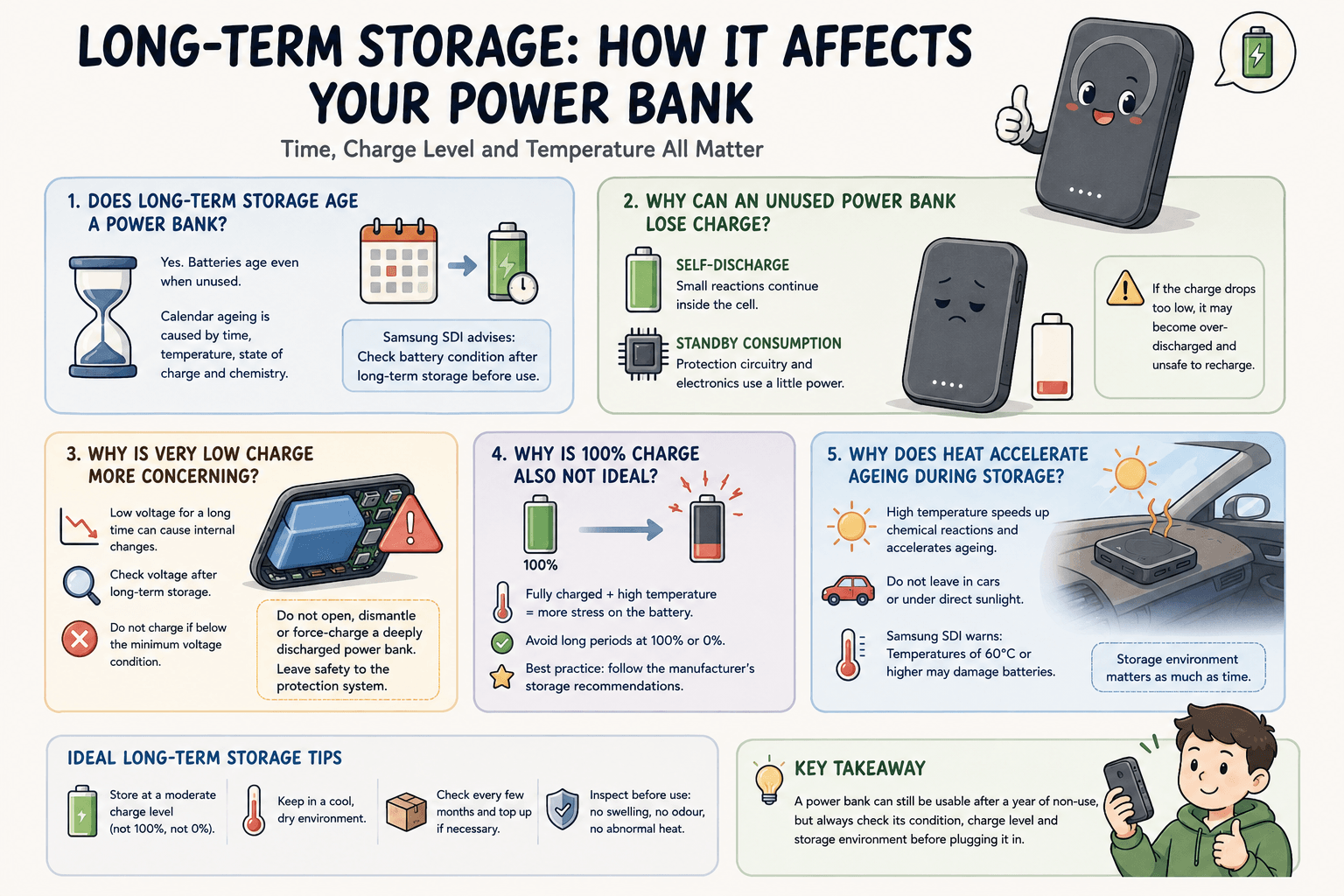
The answer is yes, although the mechanism is more nuanced.Battery ageing consists of both cycle ageing and calendar ageing.Many users assume a battery only degrades when it is charged and discharged. In reality, lithium-ion cells also age over time even when they are not being actively cycled.This is known as calendar ageing.Temperature, state of charge, time and the chemistry of the cell all influence the rate of ageing.A battery sitting unused in a drawer is therefore not chemically frozen.
It continues to change gradually.Samsung SDI’s official lithium-ion battery safety guidance states that keeping lithium-ion batteries unused for long periods can cause problems including leakage. It also advises against storing lithium-ion batteries fully charged or completely discharged, and recommends checking battery condition after long-term storage before charging and using them again.Long-term storage therefore does not automatically make a power bank unusable, but it does mean that its condition should be reassessed before reuse.
Why Can a Completely Unused Power Bank Lose Charge?
This is one of the most confusing aspects of long-term storage.A consumer may think:
“I haven’t used the power bank for a year, so why is it almost empty?”One reason is self-discharge.Lithium-ion batteries are not perfectly energy-sealed systems. Very small electrochemical reactions continue inside the cell, while the protection circuitry and other electronics may consume a small amount of energy even when no device is connected.Over long periods, that gradual loss can become significant.
If the product has relatively high standby consumption or the cell has already aged, the remaining charge may fall much further.The concern is that an extremely low state of charge can become an over-discharge condition.At that point, the question is no longer simply whether the battery has enough capacity. It becomes whether the battery remains suitable for safe recharging.
Why Is Long-Term Storage at Very Low Charge More Concerning?
Long-term storage at a completely depleted state is not an ideal condition for a lithium-ion battery.As the cell voltage falls over time, internal changes can occur and the safety of later recharging may be compromised.Samsung SDI’s safety guidance states that battery voltage should be checked after long-term storage before reuse, and specifically warns against charging cells that are below its specified minimum voltage condition.This does not mean consumers should open a power bank, access the internal cell and attempt to revive it.
The opposite is true.A consumer should not dismantle a power bank or force-charge an internal lithium cell that has been deeply discharged or behaves abnormally.Battery packs are designed with protection systems for a reason, and unauthorised modification or reassembly can introduce additional safety risks.
Why Is Long-Term Storage at 100% Charge Also Not Ideal?
Keeping a battery fully charged for months is convenient, but it is not necessarily ideal for long-term storage.Samsung SDI specifically advises against keeping lithium-ion batteries fully charged or completely discharged for long periods.High state of charge can increase electrochemical stress, particularly when combined with elevated temperature.
The better long-term-storage principle is therefore not simply “charge it to 100% and forget it” or “drain it to zero and leave it in a drawer”.The exact storage recommendation should follow the manufacturer’s instructions, while avoiding prolonged storage at extreme states of charge.
Why Does Heat Accelerate Battery Ageing During Storage?
If a power bank spends a year in a stable indoor environment, its ageing conditions are very different from a device left inside a hot car.Higher temperatures accelerate chemical reactions inside lithium-ion cells.This does not mean that one hot day will automatically cause a fire, but prolonged exposure to high temperatures can accelerate degradation and affect battery materials, seals and electronics.
Samsung SDI explicitly advises against exposing lithium-ion batteries to heat or direct sunlight and warns against storing them in cars exposed to direct sunlight. Its published guidance notes that exposure to temperatures of 60°C or higher may damage batteries.For a long-stored power bank, therefore, “How long was it unused?” is only part of the question.
Another is:Where was it stored?
Real Cases: Storage Is Not the Only Cause, but Ageing Batteries Can Still Become Dangerous
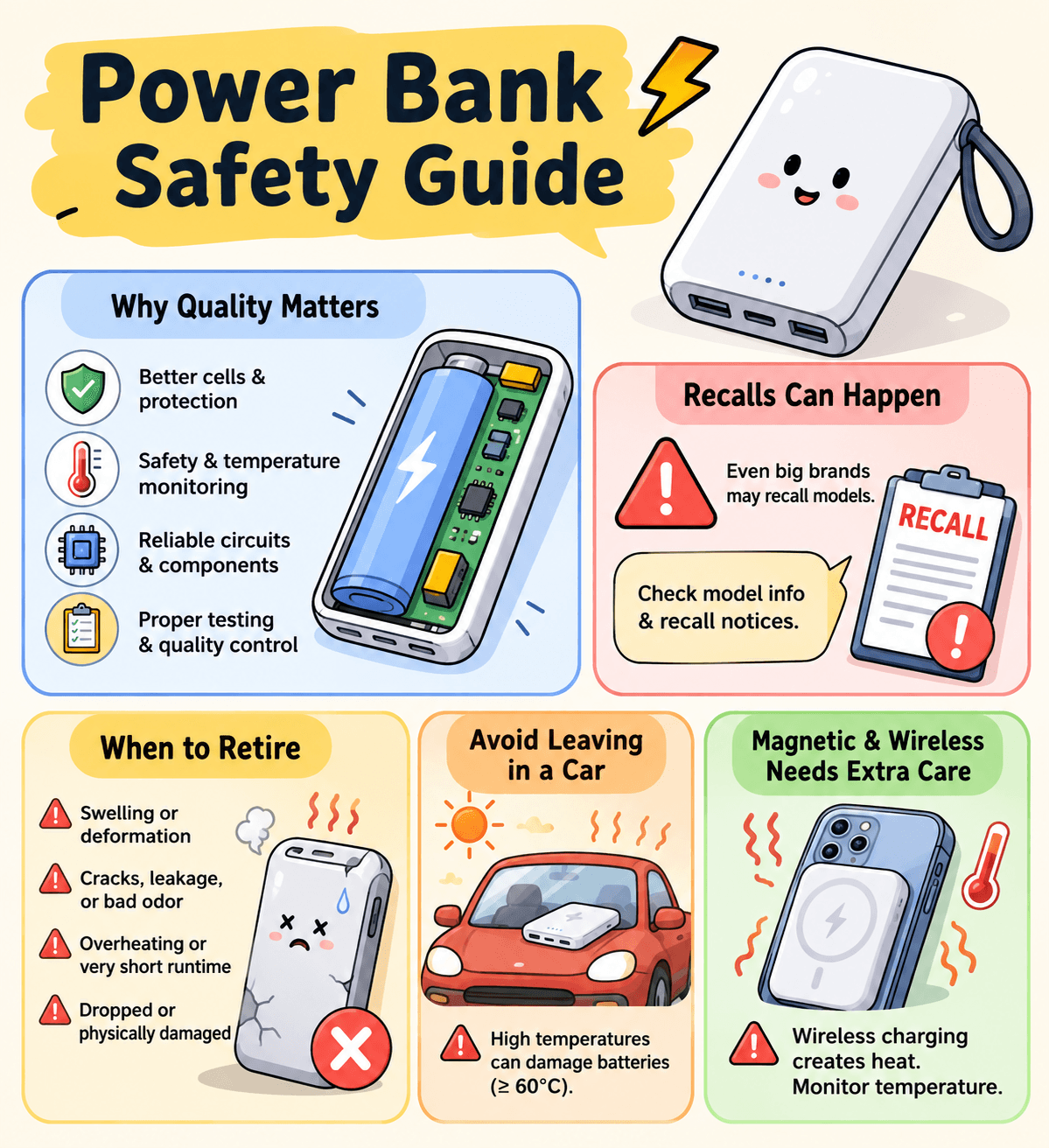
A crucial distinction needs to be made here.There is no reliable evidence supporting the statement:“A power bank becomes dangerous simply because it has been unused for one year.”Real battery incidents usually involve more complicated factors, such as cell defects, internal short circuits, physical damage, overheating, protection-system failures, charging problems or other product faults.
We should therefore not attribute every fire to long-term storage.However, official recalls demonstrate that when lithium-ion battery systems contain a defect, overheating, swelling and fire can have serious consequences.That is why a long-stored product deserves inspection before being returned to service.
Casely Magnetic Wireless Power Bank: A 2026 Recall Involving a Reported Fatality
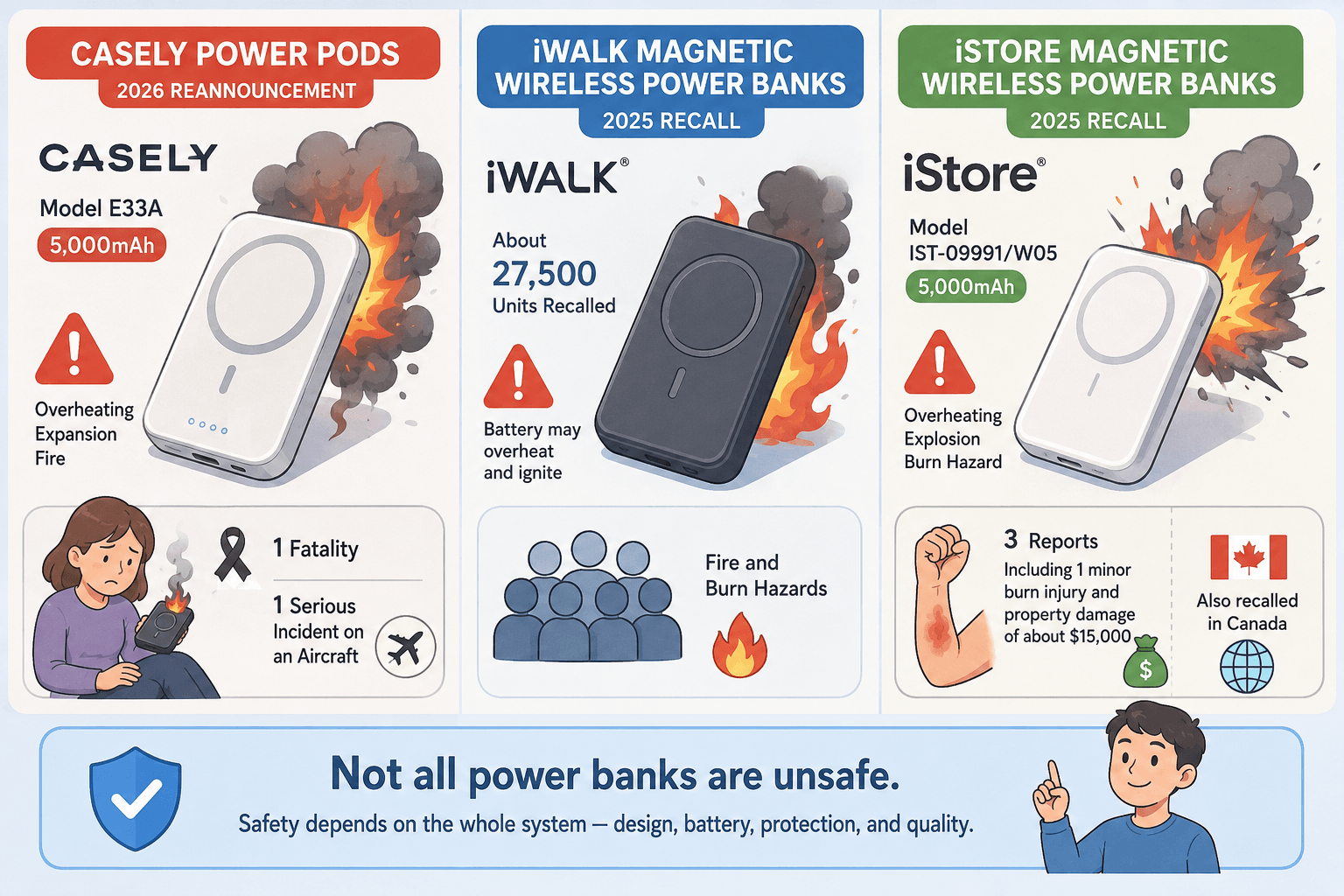
In April 2026, the US Consumer Product Safety Commission reannounced the recall of Casely Power Banks, a 5,000mAh MagSafe-compatible wireless portable phone charger.The CPSC stated that the lithium-ion battery could overheat and ignite, creating a risk of serious injury or death.
After the original recall in 2025, the company received another 28 reports involving overheating, expansion or fire. According to the CPSC, the additional incidents included one reported fatality and a serious incident on an aircraft. The agency said a 75-year-old New Jersey woman suffered second- and third-degree burns when the power bank caught fire and exploded in August 2024 and later died from complications related to her injuries. In February 2026, a 47-year-old woman experienced a fire and explosion involving the power bank on an aircraft and suffered first-degree burns.
This does not mean that magnetic power banks as a category are unsafe.It demonstrates that a defective lithium-ion battery product can have severe consequences.Consumers can check the official recall notice here: Official CPSC Casely recall notice
iWALK Magnetic Wireless Power Banks: About 27,500 Units Recalled
In May 2025, the CPSC recalled approximately 27,500 iWALK Magnetic Wireless Power Banks.The agency stated that lithium-ion batteries in the recalled units could overheat and ignite, creating fire and burn hazards and the risk of serious injury or death.This case is particularly relevant because these were explicitly marketed as magnetic wireless power banks.The lesson is not that magnetic charging is inherently unsafe.It is that the presence of magnets or wireless charging does not eliminate the underlying responsibilities of battery engineering and manufacturing.
iStore Magnetic Wireless Power Banks: Overheating, Expansion and Reported Explosions
In 2025, the CPSC recalled iStore Magnetic Wireless Power Banks, model IST-09991/W05.The agency stated that the lithium-ion battery could overheat and ignite while charging. The recall followed reports involving overheating and explosions, including an incident involving a minor burn and property damage.For long-stored power banks, this reinforces an important point:
The fact that a device can still charge does not prove that it is safe to continue using.Consumers should also inspect for swelling, deformation, abnormal temperature, charging-port damage and unusual behaviour during wireless charging.
ESR HaloLock: Recall Expanded to Additional Wireless Power Bank Models
The ESR HaloLock case provides another important lesson:Product-safety investigations can expand when additional affected configurations are identified.The CPSC has recalled ESR HaloLock Wireless Power Banks because the lithium-ion batteries could overheat and ignite, with the recall later expanding to additional models.This matters to brands because a product’s lifecycle is much longer than the day it leaves the factory.
Products may spend months in warehouses.They may remain in a distributor’s inventory for a year.A consumer may buy one and then leave it unused for several years.Manufacturers therefore need to think beyond factory release and consider how products behave during storage, distribution and long-term ownership.
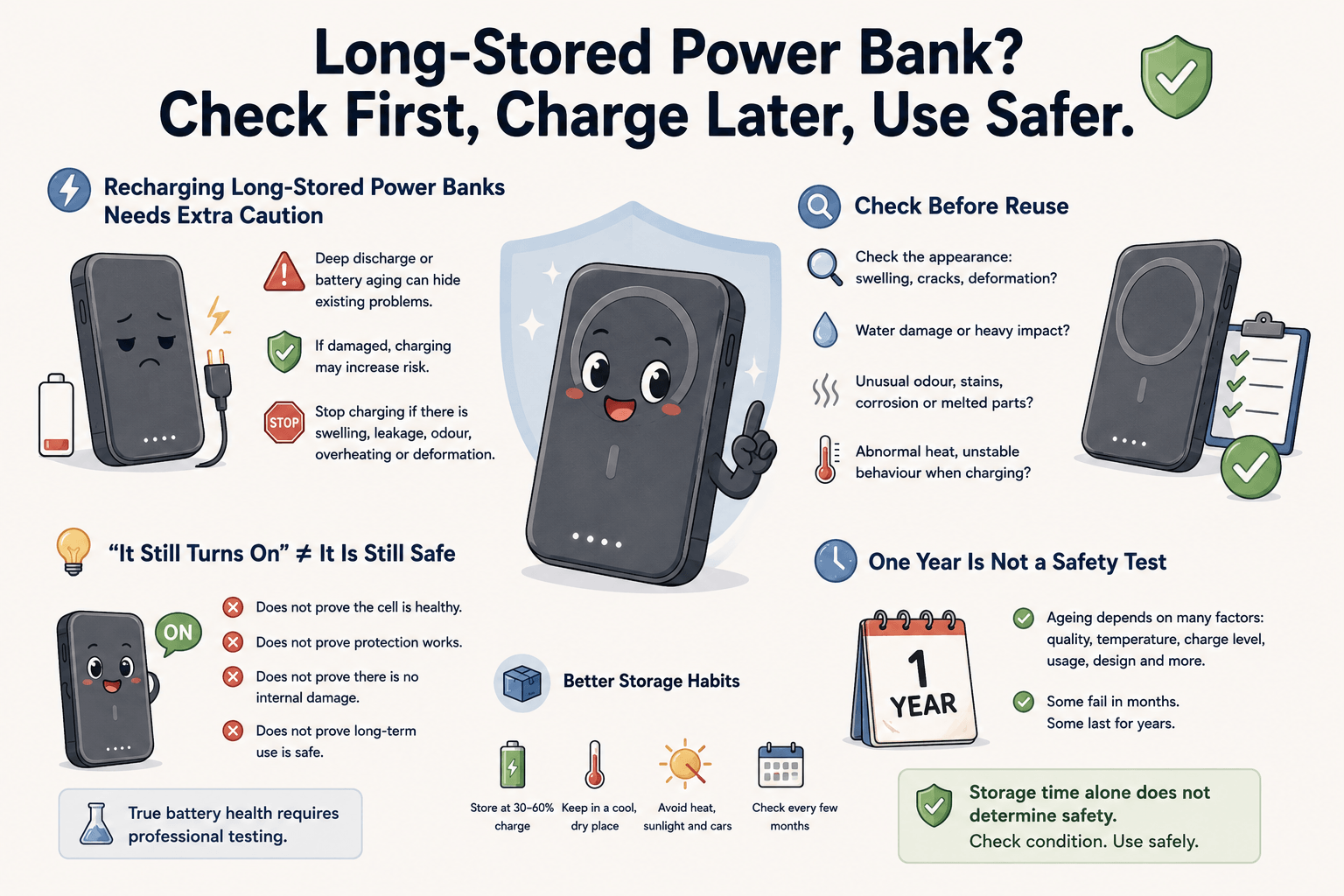
Why Can Recharging a Long-Stored Power Bank Require Extra Caution?
This is where many consumers make a mistake.They find a completely discharged power bank and immediately connect it to a high-power charger.If the battery has already aged significantly or experienced deep discharge, that is not necessarily the safest approach.A properly functioning power bank should use its protection system to manage charging.
However, if the cell has been damaged, degraded or is already outside its safe operating condition, reconnecting the charger can expose an existing problem.Samsung SDI’s safety guidance says charging should be stopped when a lithium-ion battery or battery pack shows swelling, deformation, discolouration, leakage, unusual odour or overheating.For a long-stored power bank, the first step should therefore not be “charge it to full”.
The first step should be:Inspect it.
What Should You Check Before Reusing a Power Bank After Long-Term Storage?
A long-stored power bank should first be inspected physically.If the housing is swollen, lifting, cracked or deformed, it should not be used.Products that have been dropped, crushed or exposed to water also deserve additional caution.Unusual chemical or burning smells, darkened charging ports, melting or corrosion are strong reasons not to continue charging.
If the product behaves abnormally when connected to a charger, such as becoming unusually hot or repeatedly starting and stopping, charging should be stopped.
The principle is simple:An obvious abnormality should not be tested by repeatedly charging the device to “see what happens”.
“It Still Turns On” Does Not Mean “It Is Still Safe”
A device powering on only proves that some electrical functions remain operational.It does not prove that:The cell has not degraded.The protection circuit is functioning correctly.The battery has not suffered internal damage.Thermal behaviour is normal.Or long-term use will be safe.
For a long-stored lithium battery product, visible appearance and basic functionality are only the first level of assessment.Accurate battery health requires appropriate technical testing.This is why battery inspection, ageing tests and finished-product validation are important manufacturing processes.
Why Is One Year Not a Sufficient Safety Test?
A power bank used after one year may work perfectly well.Another one stored for only eight months may already show swelling.A third may remain functional after several years.That is not contradictory.Battery ageing depends on many variables, including cell chemistry, manufacturing quality, storage temperature, initial state of charge, standby consumption, protection design and previous use.A professional statement is therefore:
Long-term storage can accelerate or reveal battery ageing, but storage time alone does not determine whether a power bank is safe.
That is far more accurate than saying: A power bank becomes unsafe after one year.
For a professional manufacturer’s website, this distinction is important because credibility matters.
Why Are Poor-Quality Power Banks More Concerning?
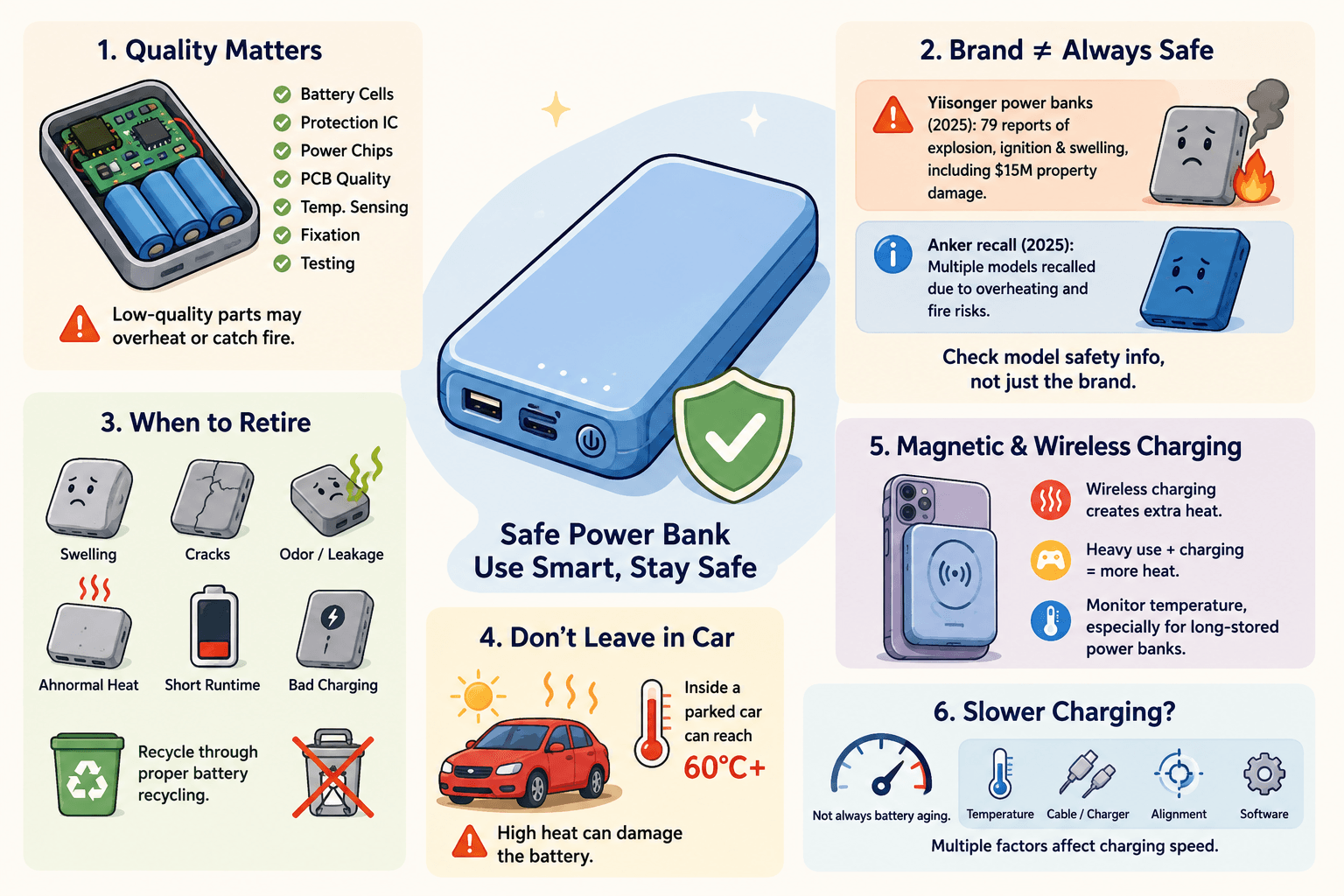
The problem with low-quality power banks is not simply that they are inexpensive.The concern is where manufacturing costs may have been reduced.Battery cells.Protection components.Power semiconductors.PCB construction.Temperature sensing.Mechanical fixation.Testing.
Many of these factors are invisible to the consumer.In May 2025, the CPSC warned consumers to stop using certain Yiisonger power banks because the lithium-ion batteries could overheat and ignite. The agency reported 79 reports involving explosion, ignition and swelling, including a serious fire that caused approximately $15 million in property damage.This does not mean that every low-cost product is unsafe.It demonstrates that consumers cannot judge internal battery and protection quality from exterior appearance alone.
The Anker Recall Also Shows Why Brand Recognition Alone Is Not Enough
The US CPSC also recalled multiple Anker power-bank models in 2025 because lithium-ion batteries could overheat and create fire and burn hazards. The affected models included A1647, A1652, A1257, A1681 and A1689, with some supporting MagSafe or outputs up to 30W.The lesson is not that major brands are unreliable.It is that brand recognition alone cannot replace model-specific safety evaluation.A mature brand should also have the systems required to identify affected products, communicate recalls and provide remedies when problems are discovered.
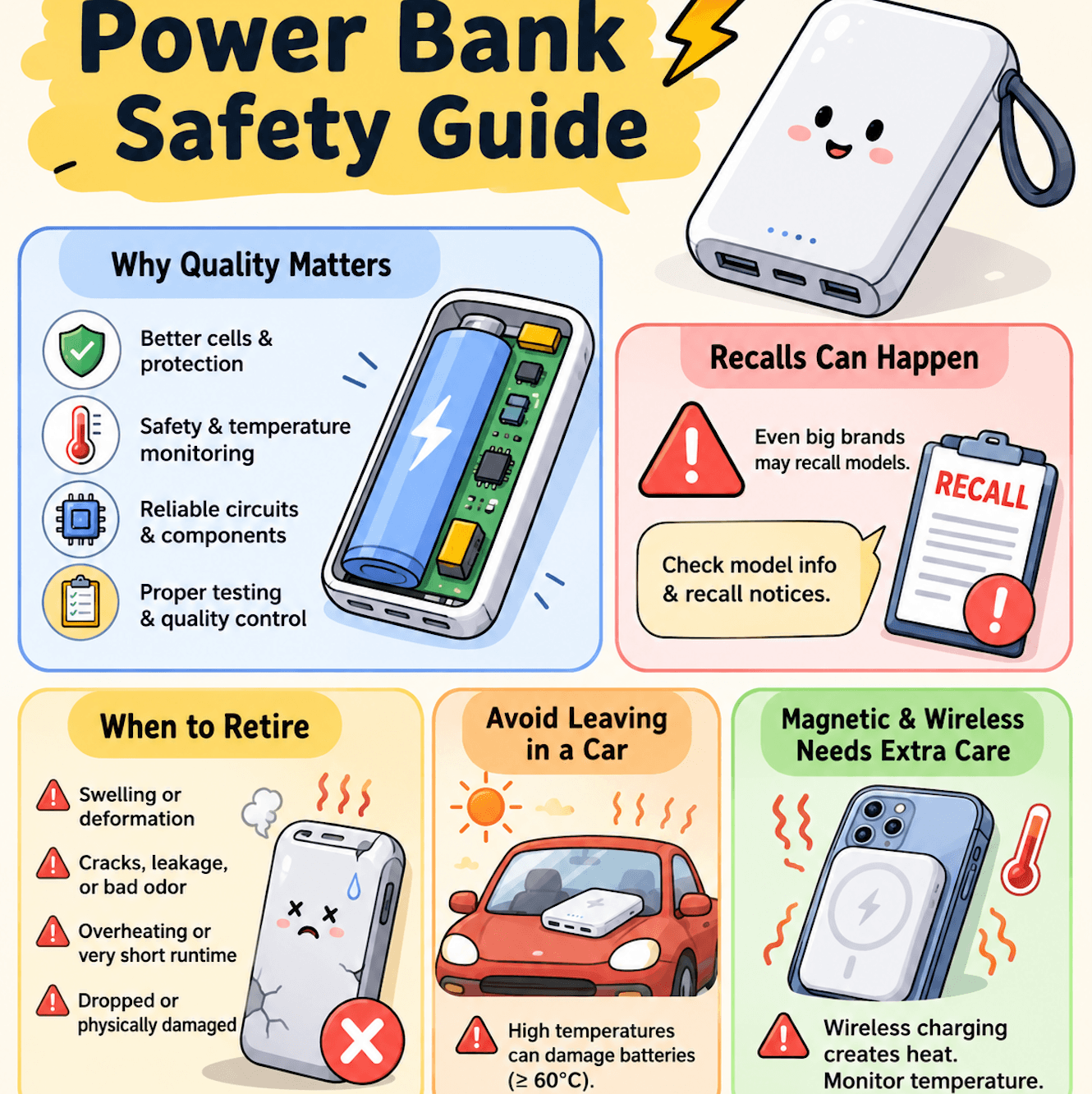
When Should a Long-Stored Power Bank Simply Be Retired?
Not every old power bank needs to be discarded simply because of age.However, a product showing clear swelling, deformation, cracking, leakage, unusual odour, abnormal heat or charging behaviour should no longer be treated as a normal device.The same applies to products that have suffered serious impact.
A power bank that has lost significant capacity and simultaneously becomes unusually hot during charging should also be treated cautiously.The fact that it can still transfer a small amount of energy does not mean continued use is worthwhile.Damaged or recalled lithium-ion products should be disposed of through the appropriate local recycling or hazardous-battery process.
Why Should You Avoid Leaving a Power Bank in a Car?
The inside of a vehicle is a classic example of poor battery storage.Temperatures can rise rapidly inside a parked car, especially under direct sunlight.A power bank may be used only occasionally, but storing it in a car or boot for months can expose it to repeated high-temperature stress.Samsung SDI specifically warns against storing lithium-ion batteries in vehicles exposed to direct sunlight and notes that temperatures at or above 60°C may damage batteries.
Why Do Magnetic Power Banks Require Additional Thermal Consideration?
Magnetic power banks introduce another thermal factor compared with conventional wired power banks: wireless charging.Wireless power transfer is not perfectly efficient, and some energy is lost as heat.Because a magnetic power bank is physically attached to the back of the phone, the two devices are close together during charging.
If the phone is already operating under heavy load while the power bank is wirelessly charging, both devices may generate heat at the same time.A long-stored magnetic power bank should therefore be monitored particularly carefully during wireless charging.A sudden increase in temperature compared with previous use deserves attention.
Does Suddenly Slower Charging Mean the Battery Has Aged?
Possibly, but not necessarily.Charging speed can be affected by phone temperature, battery temperature, charging protocols, output power, wireless alignment, cable quality, charger capability and software controls.A reduction in charging speed alone does not prove battery failure.However, if a long-stored power bank simultaneously shows slower charging, much shorter runtime, increased heat, unstable battery readings and unexpected shutdowns, battery degradation or a system fault becomes more plausible.
How Should You Store a Power Bank You Will Not Use for a Long Time?
For long-term storage, the basic principles are straightforward.Avoid extreme temperatures.Avoid prolonged storage at either a fully charged or fully discharged state.Keep the product dry and at a stable room temperature.Keep it away from direct sunlight.
Samsung SDI recommends storing lithium-ion batteries in dry, room-temperature conditions and advises against refrigerators or freezers. It also specifically warns against keeping them fully charged or completely discharged for long periods.For a specific power bank, the manufacturer’s instructions should take priority over generic internet advice.
Storage requirements can vary with battery chemistry, design and protection architecture.It is also sensible to inspect a long-stored product periodically rather than placing it in a drawer for several years without checking it.
Why Should Manufacturers Care About What Happens After One Year in Inventory?
For consumers, this issue may seem minor.For brands and manufacturers, it is fundamental.A product does not necessarily go from factory to consumer immediately.
It may spend time in shipping.It may remain in an overseas warehouse.It may sit with a distributor for six months.It may become slow-moving inventory for a year.It may then spend several more years in a consumer’s home.
A mature battery product therefore needs to be designed around the whole lifecycle:
Factory → Storage → Distribution → Retail → Consumer → Long-Term Use
This is why battery traceability, inventory conditions, production dates, batch control and recall systems matter.
How Can You Find a Properly Manufactured Power Bank?
For consumers, choosing a properly manufactured power bank should involve more than capacity and price.Look for an identifiable brand, a specific model number, clear instructions, accessible support and appropriate compliance information.
Technical specifications also matter, but capacity alone is insufficient.Output wattage is only one specification.Wireless charging power is only another.What matters is whether the complete battery and charging system has been properly engineered.
What Manufacturing Information Should B2B Buyers Review?
For a brand, Amazon seller, independent retailer, wholesaler or distributor, supplier evaluation should go much deeper.You should understand what cells are used, where they come from, how batches are controlled, what incoming inspections are performed, how PCB assemblies are tested, how charging and discharging are validated, how thermal performance is checked, how wireless charging is evaluated and how finished products undergo reliability testing.These factors determine whether the product can remain consistent at scale.
This is particularly important for OEM and ODM products.Statements such as:
“Battery is good.”“Quality is guaranteed.”“Best price.”are not technical evidence.
“Battery is good.”“Quality is guaranteed.”“Best price.”are not technical evidence.
A capable manufacturer should be able to explain the manufacturing process and quality controls behind the product.
For battery-powered products, supply-chain transparency matters.If design, batteries, PCBs, assembly, testing and packaging are handled by completely separate organisations, changes in any one stage can affect the final product.A source factory can manage these manufacturing stages within one coordinated system.Changes in battery batches can be reviewed by engineering and quality teams.
Changes to wireless charging architecture can be revalidated for thermal and power performance.Structural modifications can be checked for battery fixation and heat dissipation.Long-term inventory problems can be traced by production batch.
This is particularly valuable for OEM and ODM brands because they need more than one successful shipment. They need a product platform that can remain consistent over time.
Should You Reuse or Replace a Long-Stored Power Bank?
A power bank that has been unused for one year does not automatically need to be discarded if it has been stored appropriately, shows no damage, behaves normally during inspection and is not subject to a recall.However, continued use becomes difficult to justify when there is swelling, deformation, unusual heat, abnormal odour, severe capacity loss, charging instability or obvious physical damage.
For a relatively inexpensive consumer product that is already several years old and has experienced long-term heat exposure and long-term storage, replacing it may make more sense than trying to restore it.For branded products, recall status should also be checked.This is more meaningful than making a decision based purely on whether the device has been stored for one, two or three years.
The Professional Rule Is Not “One Year Means Unsafe”; It Is “Abnormal Condition Means Stop”
A year is not an automatic expiry date.But long-term storage does expose lithium-ion batteries to calendar ageing, while high temperatures, prolonged full charge, complete discharge, pre-existing cell defects and poor storage conditions can reduce safety margins. Samsung SDI recommends checking batteries after long-term storage and stopping use when swelling, deformation, leakage, unusual odour or overheating is observed.
At the same time, official CPSC recalls demonstrate that lithium-ion power banks can overheat and ignite when defects or failures occur, and magnetic wireless products are not exempt from those risks.
The correct consumer question is therefore not: “My power bank has been unused for a year. Is it automatically bad?”
It is: “My power bank has been unused for a year. Is it still in a normal and safe condition to use?”
That distinction is important.Time itself is not a fault. Abnormal condition is.
Conclusion: The Right Question Is What Happened to the Battery During Storage
A power bank does not automatically become unusable after one year of non-use.However, long-term storage is not something that should be ignored.Lithium-ion batteries experience calendar ageing.Long-term heat accelerates degradation.Prolonged storage at full charge or complete discharge is not ideal.
Severe drops, crushing, moisture and other physical damage can affect battery safety.Recent official CPSC recalls demonstrate that overheating, swelling and fire are real risks for defective lithium-ion power banks. The Casely, iWALK, iStore and ESR cases all reinforce the importance of model identification, battery condition and manufacturing quality rather than relying solely on price or appearance.
For consumers, the right approach is to inspect a long-stored product before reuse and check for swelling, deformation, leakage, unusual odours, abnormal heat and serious charging problems. Long-term storage in hot vehicles, direct sunlight and other unsuitable environments should also be avoided.For brands and professional buyers, the question needs to go further.
Manufacturers should not wait until a product reaches the market to ask what happens after one year in storage.Battery-cell quality, BMS protection, charging architecture, wireless charging, thermal management, mechanical design, testing, inventory conditions and batch traceability should all be considered during development and production.
Manufacturers should not wait until a product reaches the market to ask what happens after one year in storage.Battery-cell quality, BMS protection, charging architecture, wireless charging, thermal management, mechanical design, testing, inventory conditions and batch traceability should all be considered during development and production.
Magnetic power banks require even more attention because they combine lithium-ion batteries, wireless power transfer, magnetic alignment and thermal management.
Professional power-bank manufacturing is not about maximising capacity or minimising price. It is about creating the right balance between battery performance, charging efficiency, temperature control, safety and long-term reliability.



Leave a Reply