 Get 30% Off On Selected Items

Can Wireless Earbuds Really Catch Fire or Explode? Real Cases, Recalls, Safety Risks and How to Choose a Safer Product
For many people, wireless earbuds are now part of everyday life.They are used during commuting, work, exercise, travel, gaming, phone calls and entertainment, sometimes for several hours each day.As usage has increased, questions about earbud safety have also become more important.There have been documented product recalls and safety notices involving wireless earbuds, charging cases and associated charging systems because of overheating, burns or fire risks.
At the same time, not every report described online as an “earbud explosion” has been independently verified. Consumers need to distinguish between official safety findings, confirmed recalls and individual claims reported by users or media outlets.The purpose of this article is not to create unnecessary fear. It is to explain what has actually happened, how battery-related failures can occur, what warning signs consumers should recognise and how to choose a better-designed product.
Why Does Bluetooth Earbud Safety Deserve More Attention?
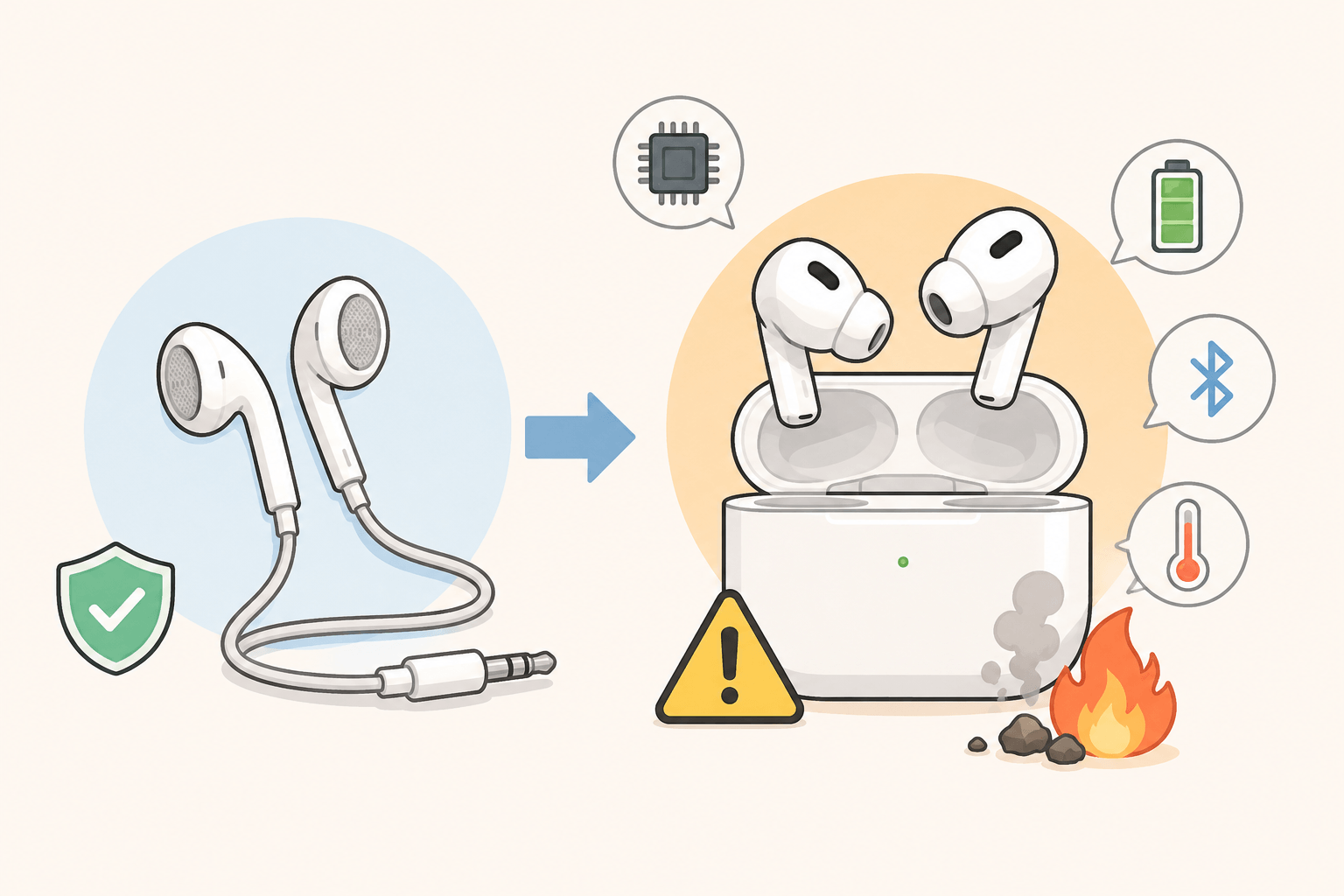
Older wired earphones were relatively simple.They primarily consisted of speakers, cables and connectors, without an integrated rechargeable battery.TWS earbuds are different.They contain lithium batteries, circuit boards, Bluetooth electronics, microphones, speakers, touch controls and charging contacts in an extremely compact space.The charging case adds another rechargeable battery and its own charging-management system.
A modern TWS product is therefore a highly integrated electronic device.It has to manage audio, wireless communication, battery charging, power conversion, thermal behaviour, structural integrity and long-term reliability at the same time.That is why earbud safety cannot be reduced to one question about battery capacity.
What Has Actually Happened? Documented Cases and Safety Reports
Audio-Technica True Wireless Earbuds Recalled in the UK
View the official UK recall notice for Audio-Technica True Wireless Headphones
This is one of the most relevant examples for UK consumers.On 19 December 2024, the UK’s Office for Product Safety and Standards published a recall notice covering certain batches of Audio-Technica True Wireless Headphones.The affected models included selected ATH-SQ1TW2 products.
The official notice identified a manufacturing defect in the charging case’s built-in battery. In some circumstances, the defect could cause the case to overheat or start a fire, creating a burn hazard for users.This is important because it was not simply an anonymous online claim. It was a formal product-safety action within the UK system.Affected consumers were instructed to stop using the products and contact Audio-Technica for a refund or upgrade.
Another Audio-Technica Charging Case Was Previously Recalled
View the official CPSC recall notice
This case highlights another important point:
The charging case itself can be part of the safety risk.In April 2021, the US CPSC announced a recall involving approximately 7,450 Audio-Technica charging cases used with ATH-CK3TW wireless headphones. The agency said the cases could overheat and pose a fire hazard. Four overheating incidents had been reported, involving damage to the cases and surfaces on which they were placed; no injuries were reported.The UK government later published a related recall notice stating that the charging case could become hot enough to melt, produce smoke and potentially ignite.
True Wireless Earbuds Recalled in Canada Because of Charging Cable Overheating
View the Health Canada recall notice
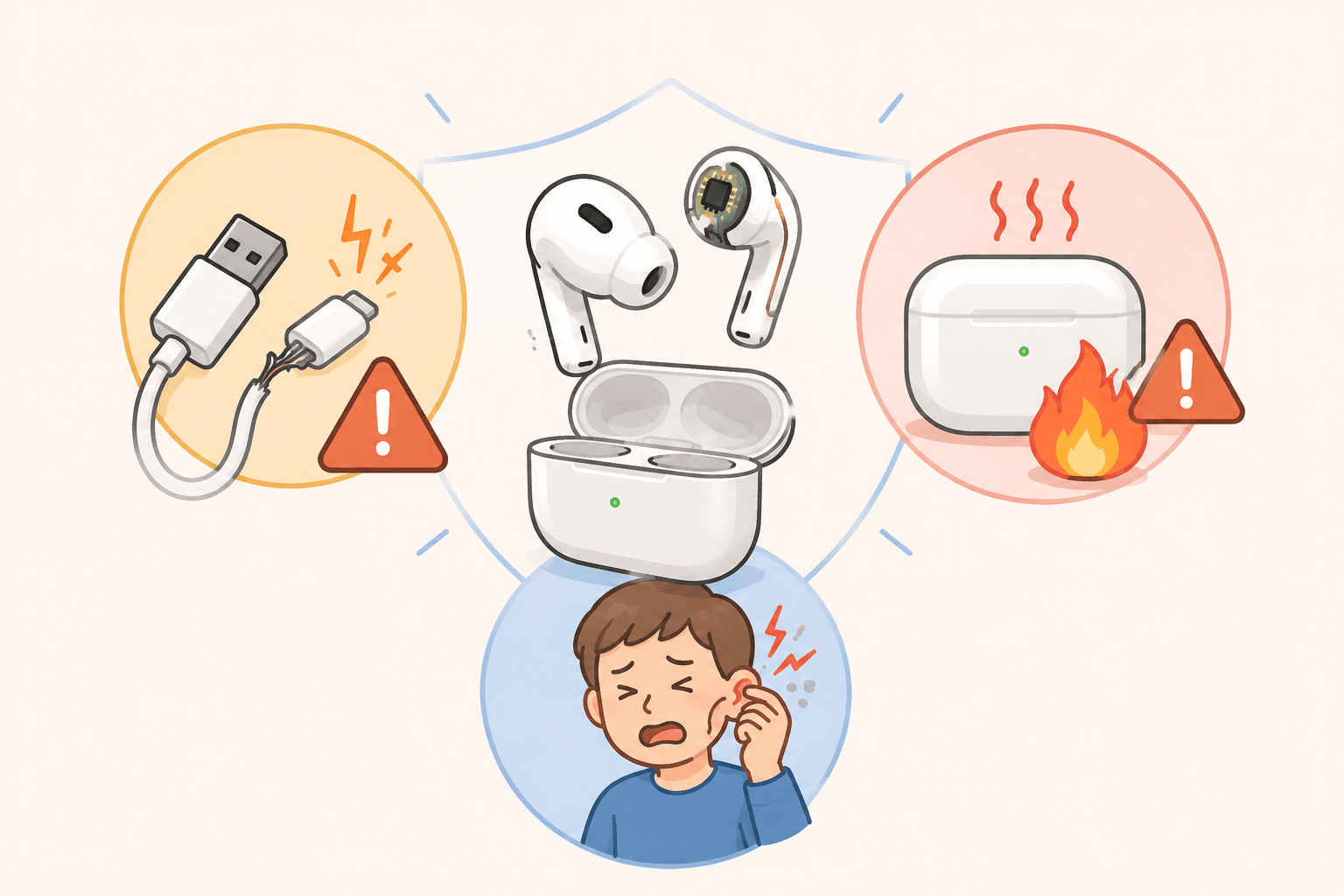
Health Canada reported a separate recall on 4 December 2025 involving True Wireless Earbuds sold in Canada.In this case, the problem was associated with the USB charging cords. The cords were manufactured using incorrect wiring material and could overheat during charging, creating burn and fire hazards. The company had received three incident reports by 27 November 2025, with no reported injuries. Approximately 16,278 units had been sold in Canada.
This case is especially useful for consumers because it demonstrates that product safety can depend on more than the earbud itself. The charging system and accessories also form part of the overall safety chain.
What About the Galaxy Buds FE “Explosion in the Ear” Story?
Read the India Today report on the reported Galaxy Buds FE incident
Read the CNET report about the reported incident
In September 2024, a Turkish Samsung community user claimed that a Galaxy Buds FE earbud suffered a serious failure while being worn by his partner and that the incident caused hearing problems.The story was subsequently covered by several media outlets, including India Today and CNET France.However, this case must be presented differently from an official recall.
The available public information is based primarily on the user’s account and subsequent media reporting. Samsung reportedly disputed the description of the event, with the company reportedly characterising the device as deformed rather than exploded.For that reason, a professional safety article should describe this as an alleged and disputed incident, not as a conclusively established product defect.This distinction matters.Good safety communication should separate documented regulatory findings from unverified or disputed individual claims.
Why Can Wireless Earbuds Overheat or Catch Fire?
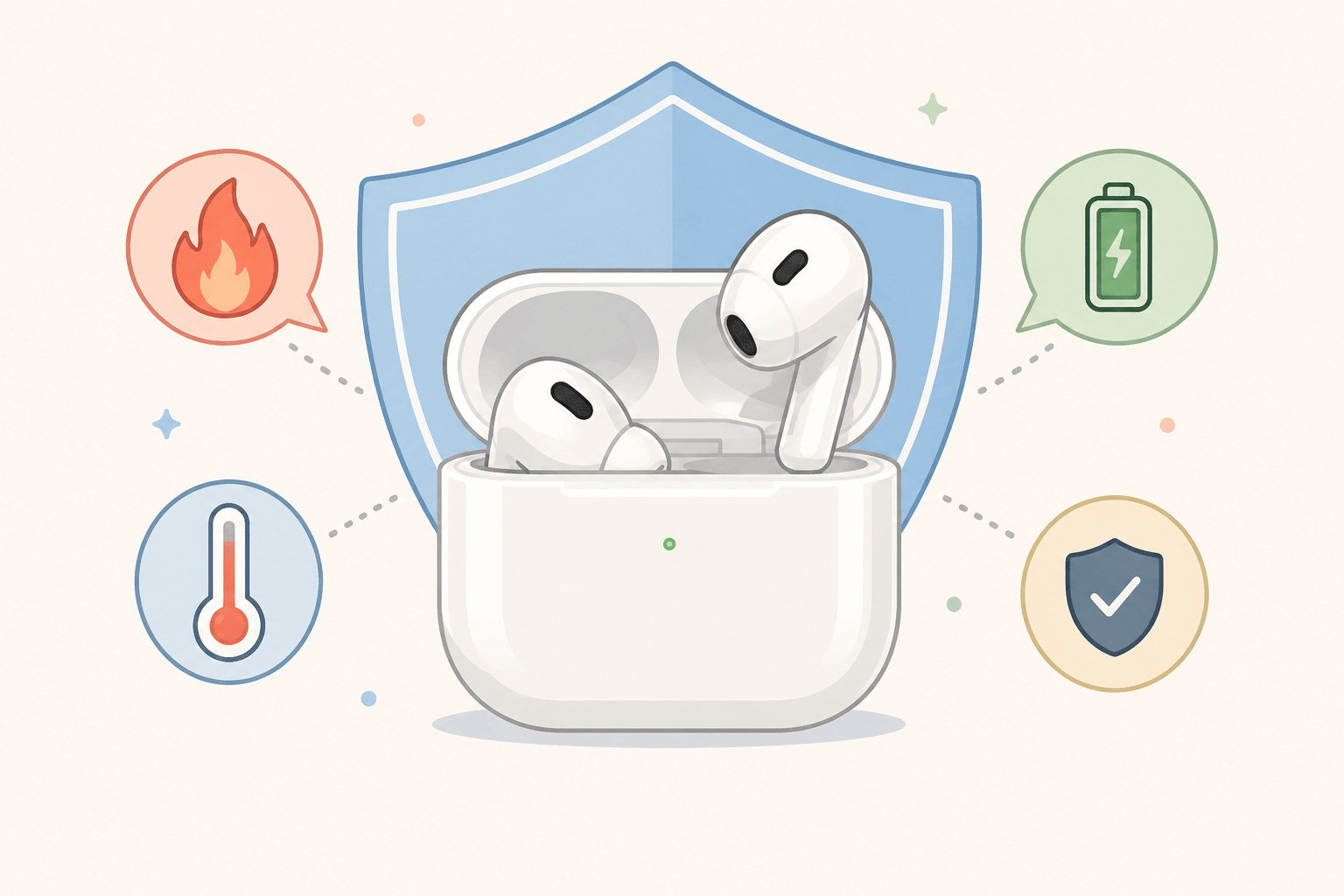
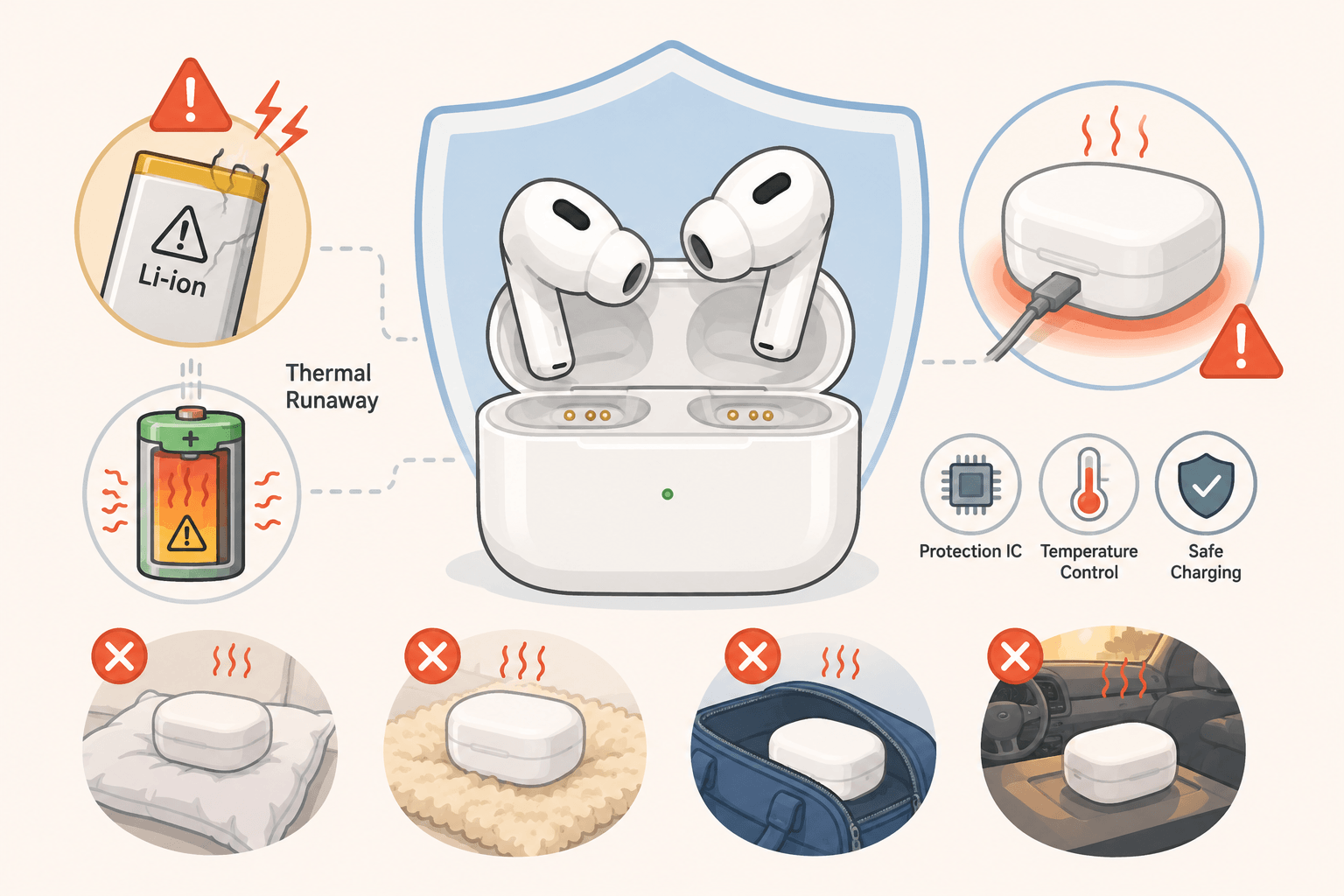
Understanding the mechanism matters more than simply saying “earbuds are dangerous”.Most modern TWS products use lithium-ion or lithium-polymer batteries.Under normal conditions, the battery operates within designed voltage, current and temperature limits.Problems can arise when the cell itself is defective, physically damaged, overheated, overcharged or when the charging and protection electronics fail to control abnormal conditions.One of the most important concepts is thermal runaway.
Thermal runaway is not simply a battery becoming warm. It is a potentially self-reinforcing failure process in which rising temperature accelerates internal reactions, generating additional heat.If the heat cannot be controlled, the battery can become increasingly unstable. In severe cases, flammable gases may be generated and the cell can rupture or ignite.Electrical Safety First identifies poor-quality or substandard components, design problems, physical damage and improper charging or discharging among factors that can contribute to lithium-battery thermal instability.
The Most Serious Problems With Poor-Quality Earbuds Are Often Invisible
Why Is the Battery Cell Central to Earbud Safety?
The cell is the energy source inside the earbud.It affects capacity, temperature behaviour, cycle life and overall reliability.Higher-quality cells generally offer stronger consistency and are subject to manufacturing checks such as capacity and resistance testing.
For a B2B buyer, the important questions are therefore not limited to:
“What is the battery capacity?”A more useful supplier evaluation asks where the cells come from, how batches are controlled, how capacity and resistance are verified, what protection architecture is used and what compliance evidence is available.Capacity tells you how much energy is stored.It does not tell you how safely that energy is controlled.
Why Is the Charging Case More Important Than Many Consumers Realise?
The TWS charging case is effectively a small rechargeable battery device.Users may return their earbuds to the case several times a day, repeatedly initiating charging cycles.The case contains its own battery, charging ICs, PCB, connectors, contacts and thermal-management considerations.It may also be left on bedside tables, desks, inside bags, on sofas or in cars, where ventilation varies significantly.Electrical Safety First recommends charging headphones on a hard, flat surface rather than on bedding or other materials that can trap heat or contribute to fire spread.
Why Can High Temperatures Increase Battery Risk?
Lithium batteries are sensitive to elevated temperatures.Charging a product in a hot vehicle is not equivalent to charging it in a normal indoor environment.High temperatures increase battery stress and accelerate ageing. As cells age, internal resistance can increase, which may produce additional heat during charging and discharging.
This can contribute to a cycle of increasing temperature and degradation.Consumers should therefore avoid leaving earbuds or charging cases in extremely hot environments, particularly inside parked vehicles, near heaters or in direct sunlight.
Why Should an Extremely Hot Earbud or Charging Case Not Be Ignored?
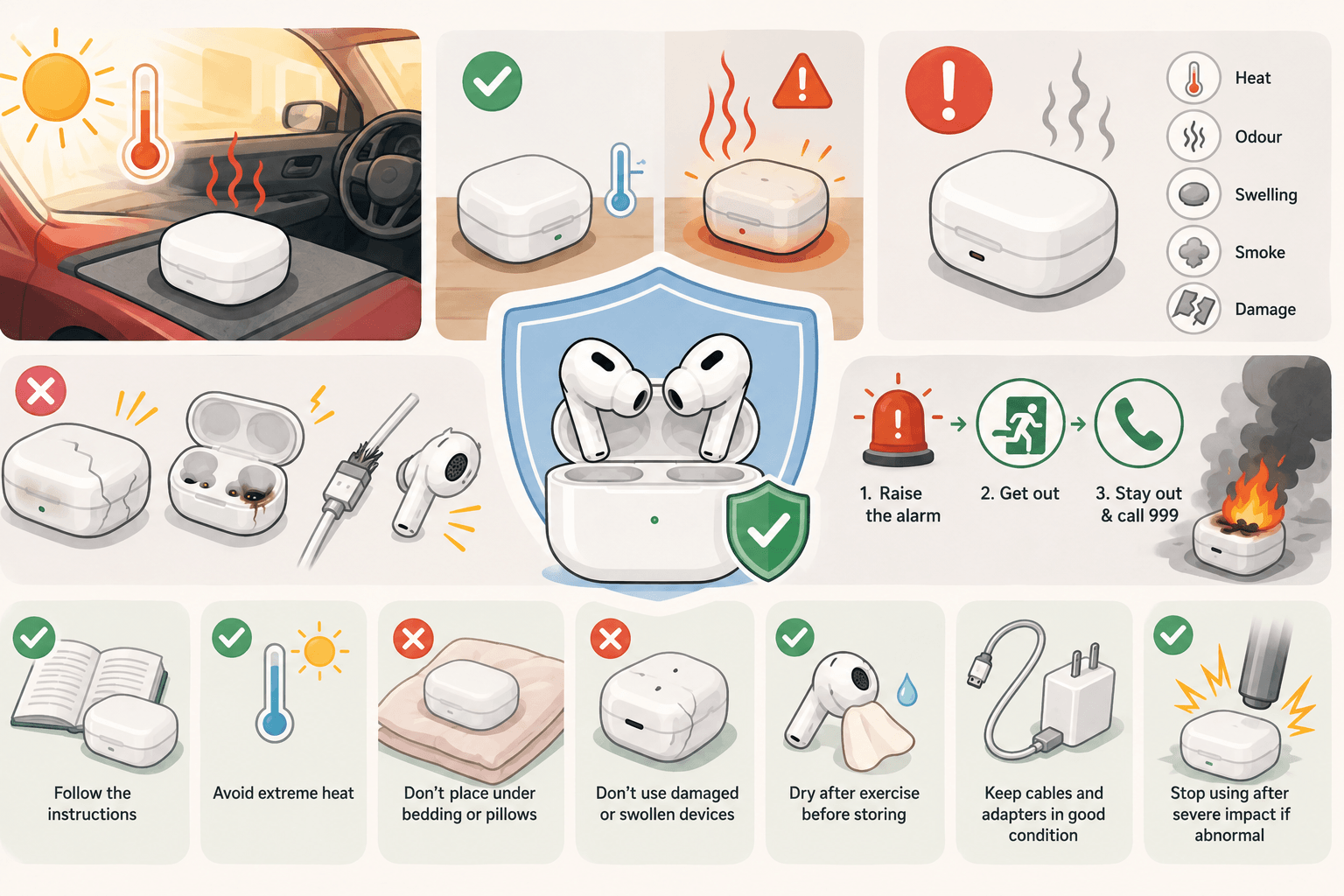
Some heat during charging or operation can be normal.The key distinction is between normal warmth and abnormal overheating.A device that becomes noticeably hotter than before, develops an unusual smell, swells, emits smoke, behaves abnormally during charging or shows physical deformation should not simply be treated as “normal fast charging”.
Audio-Technica’s own guidance instructs users to stop using a product if it malfunctions or begins producing smoke, odour, heat or other signs of damage, and warns against charging when moisture or foreign matter is present in the charging connection.
What Warning Signs Mean You Should Stop Using the Earbuds?
Many battery failures provide warning signs.Swelling, unusual chemical or burning smells, abnormal sounds, heat while the device is supposedly idle, damaged charging ports or visible scorch marks should all be treated seriously.These signs do not prove that a fire will occur, but they indicate that continued use is not appropriate.
What Should You Do If an Earbud or Charging Case Starts Smoking or Burning?
Do not continue wearing a smoking or severely overheating earbud.If it is safely possible to disconnect the power without touching a dangerously hot device, disconnect it.Do not dismantle, pierce or crush the battery.If smoke or fire has already started, do not remain nearby attempting to manage the device yourself.
UK government lithium-battery safety guidance states that if a battery or device is smoking, people should raise the alarm, get out, stay out and call 999.Damaged lithium batteries also should not simply be placed in normal household waste because defective batteries can create fire risks during collection and waste processing.
How Can Consumers Reduce Earbud Safety Risks?
Most safety precautions are simple.Use and charge the product according to its instructions.Avoid charging in extreme heat.Do not place a charging case under bedding, clothing or pillows.Do not continue using devices that are visibly swollen, deformed or damaged.
If severe impact is followed by unusual heating or charging behaviour, stop using the product even if it still plays audio.After exercise, dry the earbuds and charging contacts before returning them to the case.Keep charging cables and power adapters in good condition.
How Can You Identify a Safer Wireless Earbud?
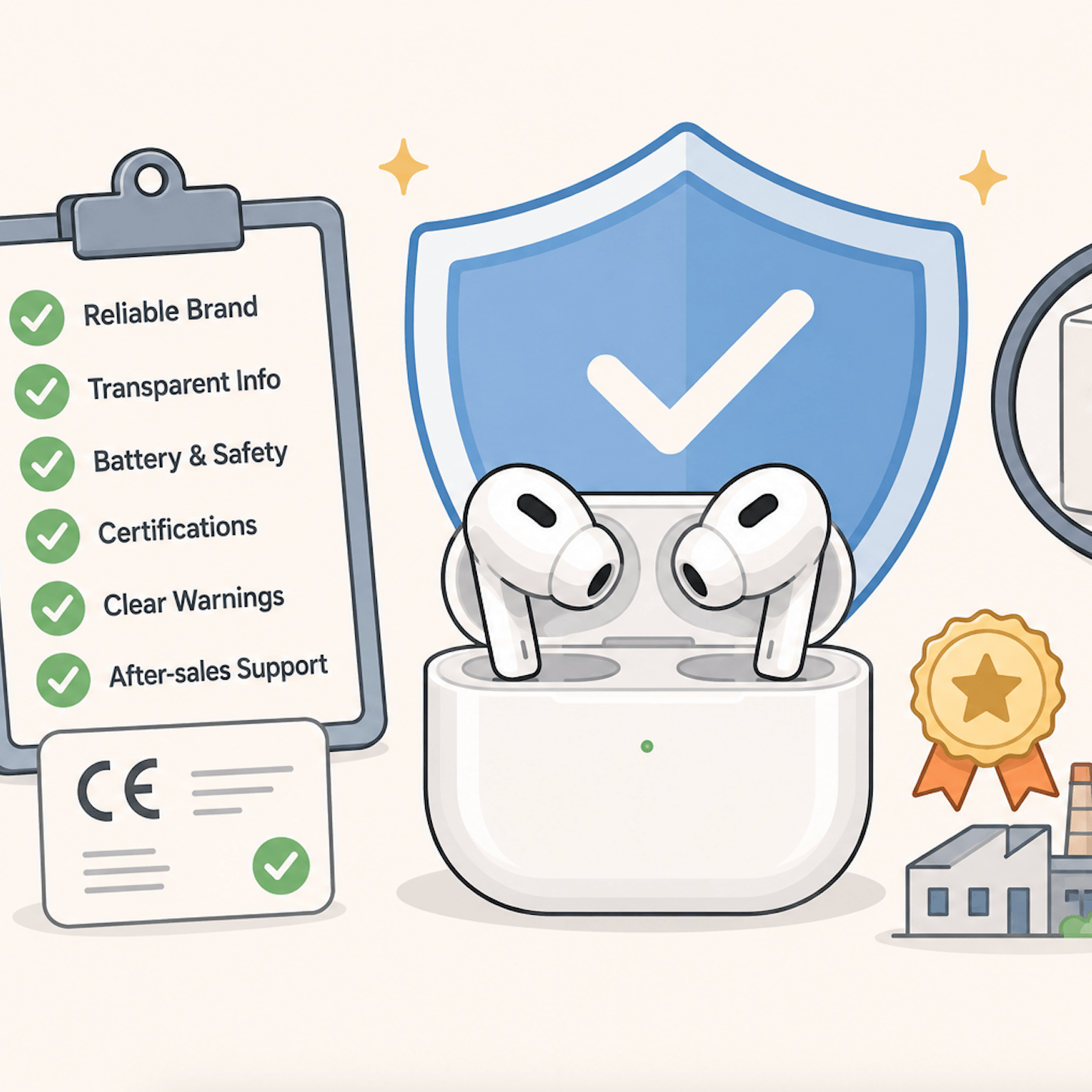
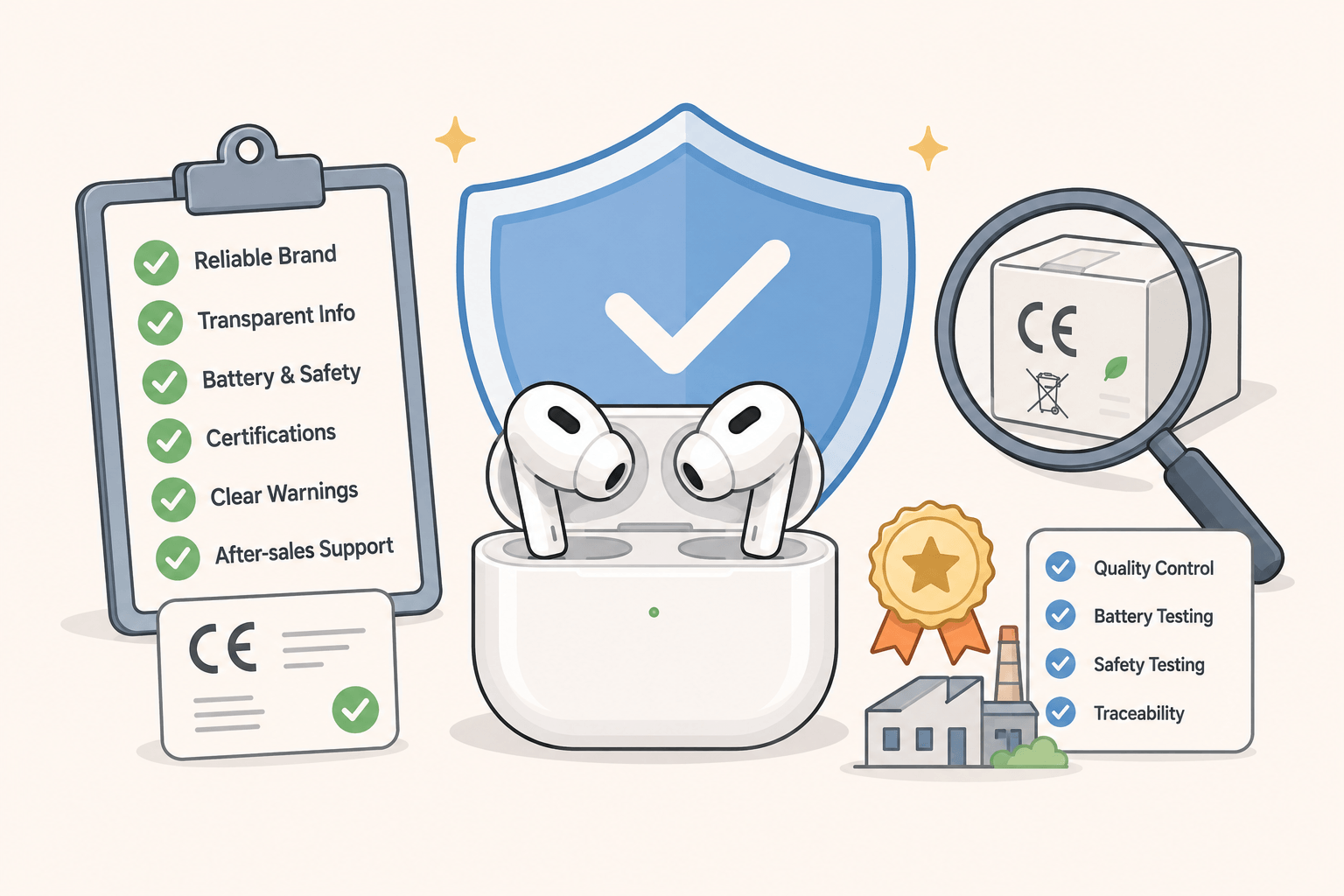
A safer buying decision should look beyond sound quality, ANC, battery life and price.Consumers and buyers should also consider:Whether the manufacturer is identifiable.Whether product information is transparent.Whether the battery and charging system are clearly documented.
Whether appropriate compliance information exists for the target market.Whether instructions and warnings are clearly provided.Whether after-sales support and recall mechanisms exist.For Bluetooth earbuds sold in Great Britain, businesses also need to consider the applicable requirements of the Radio Equipment Regulations 2017 and related conformity-assessment procedures. UK government guidance covers product safety, electromagnetic compatibility and efficient use of the radio spectrum.
Why Does a CE Mark Alone Not Guarantee Product Safety?
The presence of a compliance mark on packaging should not be treated as a standalone guarantee of product quality.Buyers should consider whether the product has actually undergone the appropriate conformity assessment, whether technical documentation exists, whether production remains consistent with the tested configuration and whether battery and radio requirements have been properly addressed.
For US products, applicable requirements such as FCC rules may also need to be considered depending on the device and its functions.Compliance is a process, not just a printed symbol.
Why Should Consumers Avoid Choosing Earbuds Solely by Lowest Price?
Low price does not automatically mean unsafe.High price does not automatically mean safe.The right question is where the cost has been reduced.Saving money on packaging or accessories may have little effect on safety.
Reducing battery quality, protection components, connector quality or testing may have very different consequences.Professional sourcing therefore asks not only for a low quotation, but for transparency about what is inside the product and how it is controlled.
For Brands, the Factory Should Be Part of the Safety Assessment
For consumers, it may be impossible to inspect the internal battery.For brands, wholesalers and distributors, supplier auditing is different.Professional buyers can ask about battery sourcing, incoming inspection, PCBA testing, charging tests, ageing tests, thermal tests, assembly quality, batch traceability, defect control and compliance documentation.
For a brand selling internationally, these areas matter because a product-safety problem can become more than a manufacturing issue. It can become a recall, customer-support problem and reputational risk.
Why Does Source Manufacturing Matter for Safety?
Manufacturing is not simply about putting components together.The battery interacts with mechanical design.Mechanical design influences heat dissipation.PCB design affects power consumption.Power consumption affects temperature.Charging contacts influence electrical reliability.
Packaging and instructions influence how consumers use the product.A genuine source factory can connect these areas directly.If a battery batch shows abnormal performance, incoming materials can be isolated.If charging contacts show reliability problems, materials and structure can be reviewed.If thermal performance is outside expectations, engineers can investigate PCB efficiency, power consumption and mechanical design together.That is one of the main values of direct manufacturing.
What Do These Real Safety Cases Actually Tell Us?
The cases do not prove that:“All wireless earbuds are dangerous.”Nor do they prove that:“Cheap earbuds will explode.”They also do not prove that an entire product range from one manufacturer has the same defect.
What they demonstrate is more specific:
Battery-powered audio products require serious engineering and safety management.
The Audio-Technica recalls show that charging-case batteries can become a source of overheating and fire risk.The Canadian recall demonstrates that charging accessories can also become part of the safety chain.The Galaxy Buds FE story is a reminder that alleged consumer incidents must be distinguished from regulator-confirmed defects.The sensible response is neither panic nor complacency.It is informed use, careful purchasing and responsible manufacturing.
What Does a Better Wireless Earbud Look Like?
A good earbud should be more than attractive and feature-rich.It should have an appropriate battery solution, reliable charging, effective protection, sensible structural engineering, suitable contact materials, transparent product information and appropriate compliance documentation.For brands, the evaluation must go deeper.
Product quality is not created by a product photograph.It is created through:
Battery selection, engineering, material control, assembly, testing and final quality management.
Conclusion: Earbud Safety Is a Manufacturing System, Not a Marketing Slogan
Wireless-earbud safety deserves attention, but it also deserves a rational approach.Official recalls have demonstrated that wireless earbuds and charging cases can, in some circumstances, develop overheating, burn or fire risks caused by battery manufacturing defects, charging-system problems or other product faults.At the same time, some widely shared “earbud explosion” stories remain based on individual claims or media reports and should not automatically be treated as confirmed technical findings.Consumers do not need to abandon wireless earbuds.
They need to choose products with transparent information, sound engineering and responsible manufacturing, while following sensible charging and usage practices.For brands and professional buyers, the evaluation should go further by examining the battery cells, PCB, protection system, materials, testing procedures and manufacturing controls behind the product.As a source manufacturer of mobile accessories and consumer electronics, we believe safety should not be added at the end of product development.It should begin with engineering and battery selection, continue through production and testing and remain part of quality control.
Our smart TWS product platform combines conventional wireless-audio functions with optional touchscreen interaction, App integration, music controls, lyrics, gaming-related features and AI translation capabilities, with OEM/ODM options for branding, packaging and product configuration.Regardless of how many smart features are eventually added, the foundation remains the same:
A wireless earbud should first be a reliable electronic product before it becomes an intelligent one.




Leave a Reply